

-
1 process areas
Программирование: процессные области -
2 set of process areas
Программирование: серия процессных областей -
3 Process flow analysis
Экономика: анализ технологического процесса (a visual representation of the various stages in a process used to identify areas of improvement) -
4 maturity level
The degree of process improvement across a predefined set of process areas in which all goals within the set are attained. -
5 near cash
!гос. фин. The resource budget contains a separate control total for “near cash” expenditure, that is expenditure such as pay and current grants which impacts directly on the measure of the golden rule.This paper provides background information on the framework for the planning and control of public expenditure in the UK which has been operated since the 1998 Comprehensive Spending Review (CSR). It sets out the different classifications of spending for budgeting purposes and why these distinctions have been adopted. It discusses how the public expenditure framework is designed to ensure both sound public finances and an outcome-focused approach to public expenditure.The UK's public spending framework is based on several key principles:"consistency with a long-term, prudent and transparent regime for managing the public finances as a whole;" "the judgement of success by policy outcomes rather than resource inputs;" "strong incentives for departments and their partners in service delivery to plan over several years and plan together where appropriate so as to deliver better public services with greater cost effectiveness; and"the proper costing and management of capital assets to provide the right incentives for public investment.The Government sets policy to meet two firm fiscal rules:"the Golden Rule states that over the economic cycle, the Government will borrow only to invest and not to fund current spending; and"the Sustainable Investment Rule states that net public debt as a proportion of GDP will be held over the economic cycle at a stable and prudent level. Other things being equal, net debt will be maintained below 40 per cent of GDP over the economic cycle.Achievement of the fiscal rules is assessed by reference to the national accounts, which are produced by the Office for National Statistics, acting as an independent agency. The Government sets its spending envelope to comply with these fiscal rules.Departmental Expenditure Limits ( DEL) and Annually Managed Expenditure (AME)"Departmental Expenditure Limit ( DEL) spending, which is planned and controlled on a three year basis in Spending Reviews; and"Annually Managed Expenditure ( AME), which is expenditure which cannot reasonably be subject to firm, multi-year limits in the same way as DEL. AME includes social security benefits, local authority self-financed expenditure, debt interest, and payments to EU institutions.More information about DEL and AME is set out below.In Spending Reviews, firm DEL plans are set for departments for three years. To ensure consistency with the Government's fiscal rules departments are set separate resource (current) and capital budgets. The resource budget contains a separate control total for “near cash” expenditure, that is expenditure such as pay and current grants which impacts directly on the measure of the golden rule.To encourage departments to plan over the medium term departments may carry forward unspent DEL provision from one year into the next and, subject to the normal tests for tautness and realism of plans, may be drawn down in future years. This end-year flexibility also removes any incentive for departments to use up their provision as the year end approaches with less regard to value for money. For the full benefits of this flexibility and of three year plans to feed through into improved public service delivery, end-year flexibility and three year budgets should be cascaded from departments to executive agencies and other budget holders.Three year budgets and end-year flexibility give those managing public services the stability to plan their operations on a sensible time scale. Further, the system means that departments cannot seek to bid up funds each year (before 1997, three year plans were set and reviewed in annual Public Expenditure Surveys). So the credibility of medium-term plans has been enhanced at both central and departmental level.Departments have certainty over the budgetary allocation over the medium term and these multi-year DEL plans are strictly enforced. Departments are expected to prioritise competing pressures and fund these within their overall annual limits, as set in Spending Reviews. So the DEL system provides a strong incentive to control costs and maximise value for money.There is a small centrally held DEL Reserve. Support from the Reserve is available only for genuinely unforeseeable contingencies which departments cannot be expected to manage within their DEL.AME typically consists of programmes which are large, volatile and demand-led, and which therefore cannot reasonably be subject to firm multi-year limits. The biggest single element is social security spending. Other items include tax credits, Local Authority Self Financed Expenditure, Scottish Executive spending financed by non-domestic rates, and spending financed from the proceeds of the National Lottery.AME is reviewed twice a year as part of the Budget and Pre-Budget Report process reflecting the close integration of the tax and benefit system, which was enhanced by the introduction of tax credits.AME is not subject to the same three year expenditure limits as DEL, but is still part of the overall envelope for public expenditure. Affordability is taken into account when policy decisions affecting AME are made. The Government has committed itself not to take policy measures which are likely to have the effect of increasing social security or other elements of AME without taking steps to ensure that the effects of those decisions can be accommodated prudently within the Government's fiscal rules.Given an overall envelope for public spending, forecasts of AME affect the level of resources available for DEL spending. Cautious estimates and the AME margin are built in to these AME forecasts and reduce the risk of overspending on AME.Together, DEL plus AME sum to Total Managed Expenditure (TME). TME is a measure drawn from national accounts. It represents the current and capital spending of the public sector. The public sector is made up of central government, local government and public corporations.Resource and Capital Budgets are set in terms of accruals information. Accruals information measures resources as they are consumed rather than when the cash is paid. So for example the Resource Budget includes a charge for depreciation, a measure of the consumption or wearing out of capital assets."Non cash charges in budgets do not impact directly on the fiscal framework. That may be because the national accounts use a different way of measuring the same thing, for example in the case of the depreciation of departmental assets. Or it may be that the national accounts measure something different: for example, resource budgets include a cost of capital charge reflecting the opportunity cost of holding capital; the national accounts include debt interest."Within the Resource Budget DEL, departments have separate controls on:"Near cash spending, the sub set of Resource Budgets which impacts directly on the Golden Rule; and"The amount of their Resource Budget DEL that departments may spend on running themselves (e.g. paying most civil servants’ salaries) is limited by Administration Budgets, which are set in Spending Reviews. Administration Budgets are used to ensure that as much money as practicable is available for front line services and programmes. These budgets also help to drive efficiency improvements in departments’ own activities. Administration Budgets exclude the costs of frontline services delivered directly by departments.The Budget preceding a Spending Review sets an overall envelope for public spending that is consistent with the fiscal rules for the period covered by the Spending Review. In the Spending Review, the Budget AME forecast for year one of the Spending Review period is updated, and AME forecasts are made for the later years of the Spending Review period.The 1998 Comprehensive Spending Review ( CSR), which was published in July 1998, was a comprehensive review of departmental aims and objectives alongside a zero-based analysis of each spending programme to determine the best way of delivering the Government's objectives. The 1998 CSR allocated substantial additional resources to the Government's key priorities, particularly education and health, for the three year period from 1999-2000 to 2001-02.Delivering better public services does not just depend on how much money the Government spends, but also on how well it spends it. Therefore the 1998 CSR introduced Public Service Agreements (PSAs). Each major government department was given its own PSA setting out clear targets for achievements in terms of public service improvements.The 1998 CSR also introduced the DEL/ AME framework for the control of public spending, and made other framework changes. Building on the investment and reforms delivered by the 1998 CSR, successive spending reviews in 2000, 2002 and 2004 have:"provided significant increase in resources for the Government’s priorities, in particular health and education, and cross-cutting themes such as raising productivity; extending opportunity; and building strong and secure communities;" "enabled the Government significantly to increase investment in public assets and address the legacy of under investment from past decades. Departmental Investment Strategies were introduced in SR2000. As a result there has been a steady increase in public sector net investment from less than ¾ of a per cent of GDP in 1997-98 to 2¼ per cent of GDP in 2005-06, providing better infrastructure across public services;" "introduced further refinements to the performance management framework. PSA targets have been reduced in number over successive spending reviews from around 300 to 110 to give greater focus to the Government’s highest priorities. The targets have become increasingly outcome-focused to deliver further improvements in key areas of public service delivery across Government. They have also been refined in line with the conclusions of the Devolving Decision Making Review to provide a framework which encourages greater devolution and local flexibility. Technical Notes were introduced in SR2000 explaining how performance against each PSA target will be measured; and"not only allocated near cash spending to departments, but also – since SR2002 - set Resource DEL plans for non cash spending.To identify what further investments and reforms are needed to equip the UK for the global challenges of the decade ahead, on 19 July 2005 the Chief Secretary to the Treasury announced that the Government intends to launch a second Comprehensive Spending Review (CSR) reporting in 2007.A decade on from the first CSR, the 2007 CSR will represent a long-term and fundamental review of government expenditure. It will cover departmental allocations for 2008-09, 2009-10 and 2010 11. Allocations for 2007-08 will be held to the agreed figures already announced by the 2004 Spending Review. To provide a rigorous analytical framework for these departmental allocations, the Government will be taking forward a programme of preparatory work over 2006 involving:"an assessment of what the sustained increases in spending and reforms to public service delivery have achieved since the first CSR. The assessment will inform the setting of new objectives for the decade ahead;" "an examination of the key long-term trends and challenges that will shape the next decade – including demographic and socio-economic change, globalisation, climate and environmental change, global insecurity and technological change – together with an assessment of how public services will need to respond;" "to release the resources needed to address these challenges, and to continue to secure maximum value for money from public spending over the CSR period, a set of zero-based reviews of departments’ baseline expenditure to assess its effectiveness in delivering the Government’s long-term objectives; together with"further development of the efficiency programme, building on the cross cutting areas identified in the Gershon Review, to embed and extend ongoing efficiency savings into departmental expenditure planning.The 2007 CSR also offers the opportunity to continue to refine the PSA framework so that it drives effective delivery and the attainment of ambitious national standards.Public Service Agreements (PSAs) were introduced in the 1998 CSR. They set out agreed targets detailing the outputs and outcomes departments are expected to deliver with the resources allocated to them. The new spending regime places a strong emphasis on outcome targets, for example in providing for better health and higher educational standards or service standards. The introduction in SR2004 of PSA ‘standards’ will ensure that high standards in priority areas are maintained.The Government monitors progress against PSA targets, and departments report in detail twice a year in their annual Departmental Reports (published in spring) and in their autumn performance reports. These reports provide Parliament and the public with regular updates on departments’ performance against their targets.Technical Notes explain how performance against each PSA target will be measured.To make the most of both new investment and existing assets, there needs to be a coherent long term strategy against which investment decisions are taken. Departmental Investment Strategies (DIS) set out each department's plans to deliver the scale and quality of capital stock needed to underpin its objectives. The DIS includes information about the department's existing capital stock and future plans for that stock, as well as plans for new investment. It also sets out the systems that the department has in place to ensure that it delivers its capital programmes effectively.This document was updated on 19 December 2005.Near-cash resource expenditure that has a related cash implication, even though the timing of the cash payment may be slightly different. For example, expenditure on gas or electricity supply is incurred as the fuel is used, though the cash payment might be made in arrears on aquarterly basis. Other examples of near-cash expenditure are: pay, rental.Net cash requirement the upper limit agreed by Parliament on the cash which a department may draw from theConsolidated Fund to finance the expenditure within the ambit of its Request forResources. It is equal to the agreed amount of net resources and net capital less non-cashitems and working capital.Non-cash cost costs where there is no cash transaction but which are included in a body’s accounts (or taken into account in charging for a service) to establish the true cost of all the resourcesused.Non-departmental a body which has a role in the processes of government, but is not a government public body, NDPBdepartment or part of one. NDPBs accordingly operate at arm’s length from governmentMinisters.Notional cost of a cost which is taken into account in setting fees and charges to improve comparability with insuranceprivate sector service providers.The charge takes account of the fact that public bodies donot generally pay an insurance premium to a commercial insurer.the independent body responsible for collecting and publishing official statistics about theUK’s society and economy. (At the time of going to print legislation was progressing tochange this body to the Statistics Board).Office of Government an office of the Treasury, with a status similar to that of an agency, which aims to maximise Commerce, OGCthe government’s purchasing power for routine items and combine professional expertiseto bear on capital projects.Office of the the government department responsible for discharging the Paymaster General’s statutoryPaymaster General,responsibilities to hold accounts and make payments for government departments and OPGother public bodies.Orange bookthe informal title for Management of Risks: Principles and Concepts, which is published by theTreasury for the guidance of public sector bodies.Office for NationalStatistics, ONS60Managing Public Money————————————————————————————————————————"GLOSSARYOverdraftan account with a negative balance.Parliament’s formal agreement to authorise an activity or expenditure.Prerogative powerspowers exercisable under the Royal Prerogative, ie powers which are unique to the Crown,as contrasted with common-law powers which may be available to the Crown on the samebasis as to natural persons.Primary legislationActs which have been passed by the Westminster Parliament and, where they haveappropriate powers, the Scottish Parliament and the Northern Ireland Assembly. Begin asBills until they have received Royal Assent.arrangements under which a public sector organisation contracts with a private sectorentity to construct a facility and provide associated services of a specified quality over asustained period. See annex 7.5.Proprietythe principle that patterns of resource consumption should respect Parliament’s intentions,conventions and control procedures, including any laid down by the PAC. See box 2.4.Public Accountssee Committee of Public Accounts.CommitteePublic corporationa trading body controlled by central government, local authority or other publiccorporation that has substantial day to day operating independence. See section 7.8.Public Dividend finance provided by government to public sector bodies as an equity stake; an alternative to Capital, PDCloan finance.Public Service sets out what the public can expect the government to deliver with its resources. EveryAgreement, PSAlarge government department has PSA(s) which specify deliverables as targets or aimsrelated to objectives.a structured arrangement between a public sector and a private sector organisation tosecure an outcome delivering good value for money for the public sector. It is classified tothe public or private sector according to which has more control.Rate of returnthe financial remuneration delivered by a particular project or enterprise, expressed as apercentage of the net assets employed.Regularitythe principle that resource consumption should accord with the relevant legislation, therelevant delegated authority and this document. See box 2.4.Request for the functional level into which departmental Estimates may be split. RfRs contain a number Resources, RfRof functions being carried out by the department in pursuit of one or more of thatdepartment’s objectives.Resource accountan accruals account produced in line with the Financial Reporting Manual (FReM).Resource accountingthe system under which budgets, Estimates and accounts are constructed in a similar wayto commercial audited accounts, so that both plans and records of expenditure allow in fullfor the goods and services which are to be, or have been, consumed – ie not just the cashexpended.Resource budgetthe means by which the government plans and controls the expenditure of resources tomeet its objectives.Restitutiona legal concept which allows money and property to be returned to its rightful owner. Ittypically operates where another person can be said to have been unjustly enriched byreceiving such monies.Return on capital the ratio of profit to capital employed of an accounting entity during an identified period.employed, ROCEVarious measures of profit and of capital employed may be used in calculating the ratio.Public Privatepartnership, PPPPrivate Finance Initiative, PFIParliamentaryauthority61Managing Public Money"————————————————————————————————————————GLOSSARYRoyal charterthe document setting out the powers and constitution of a corporation established underprerogative power of the monarch acting on Privy Council advice.Second readingthe second formal time that a House of Parliament may debate a bill, although in practicethe first substantive debate on its content. If successful, it is deemed to denoteParliamentary approval of the principle of the proposed legislation.Secondary legislationlaws, including orders and regulations, which are made using powers in primary legislation.Normally used to set out technical and administrative provision in greater detail thanprimary legislation, they are subject to a less intense level of scrutiny in Parliament.European legislation is,however,often implemented in secondary legislation using powers inthe European Communities Act 1972.Service-level agreement between parties, setting out in detail the level of service to be performed.agreementWhere agreements are between central government bodies, they are not legally a contractbut have a similar function.Shareholder Executive a body created to improve the government’s performance as a shareholder in businesses.Spending reviewsets out the key improvements in public services that the public can expect over a givenperiod. It includes a thorough review of departmental aims and objectives to find the bestway of delivering the government’s objectives, and sets out the spending plans for the givenperiod.State aidstate support for a domestic body or company which could distort EU competition and sois not usually allowed. See annex 4.9.Statement of Excessa formal statement detailing departments’ overspends prepared by the Comptroller andAuditor General as a result of undertaking annual audits.Statement on Internal an annual statement that Accounting Officers are required to make as part of the accounts Control, SICon a range of risk and control issues.Subheadindividual elements of departmental expenditure identifiable in Estimates as single cells, forexample cell A1 being administration costs within a particular line of departmental spending.Supplyresources voted by Parliament in response to Estimates, for expenditure by governmentdepartments.Supply Estimatesa statement of the resources the government needs in the coming financial year, and forwhat purpose(s), by which Parliamentary authority is sought for the planned level ofexpenditure and income.Target rate of returnthe rate of return required of a project or enterprise over a given period, usually at least a year.Third sectorprivate sector bodies which do not act commercially,including charities,social and voluntaryorganisations and other not-for-profit collectives. See annex 7.7.Total Managed a Treasury budgeting term which covers all current and capital spending carried out by the Expenditure,TMEpublic sector (ie not just by central departments).Trading fundan organisation (either within a government department or forming one) which is largely orwholly financed from commercial revenue generated by its activities. Its Estimate shows itsnet impact, allowing its income from receipts to be devoted entirely to its business.Treasury Minutea formal administrative document drawn up by the Treasury, which may serve a wide varietyof purposes including seeking Parliamentary approval for the use of receipts asappropriations in aid, a remission of some or all of the principal of voted loans, andresponding on behalf of the government to reports by the Public Accounts Committee(PAC).62Managing Public Money————————————————————————————————————————GLOSSARY63Managing Public MoneyValue for moneythe process under which organisation’s procurement, projects and processes aresystematically evaluated and assessed to provide confidence about suitability, effectiveness,prudence,quality,value and avoidance of error and other waste,judged for the public sectoras a whole.Virementthe process through which funds are moved between subheads such that additionalexpenditure on one is met by savings on one or more others.Votethe process by which Parliament approves funds in response to supply Estimates.Voted expenditureprovision for expenditure that has been authorised by Parliament. Parliament ‘votes’authority for public expenditure through the Supply Estimates process. Most expenditureby central government departments is authorised in this way.Wider market activity activities undertaken by central government organisations outside their statutory duties,using spare capacity and aimed at generating a commercial profit. See annex 7.6.Windfallmonies received by a department which were not anticipated in the spending review.———————————————————————————————————————— -
6 PA
1) Общая лексика: portable audio, passport agency, персональный ассистент, личный помощник (personal assistant)2) Компьютерная техника: Precision Architecture3) Биология: protective agent4) Медицина: posterior-anterior5) Американизм: Palestinian Authority, Past Action, People Authority, Personal Assassin, Post Apocalyptic, Process The Acronym, Public Address7) Латинский язык: physiotherapy aid8) Военный термин: Performance Accountability, Personal Authority, Physician Assistant, Picatinny Arsenal (СВ), Powered Armor, Precautionary Approach, Probability of Arrival, Processing Activities, Procurement Agency, Procurement Army, Procurement, Army, Product Assurance, Public Affairs, Pulse Amplitude, pack artillery, participating activity, patient, patrol aircraft, pattern analysis, penetration aircraft, permanent appointment, personal affairs, personal assistant, personnel allocation, phased antenna, physician's assistant, pilot's associate, point of aim, port agency, position area, position of assembly, post adjutant, practice ammunition, preavailability, prelaunch area, preliminary acceptance, primary armament, probability of acceptance, procurement appropriations, program account, program administrator, program analyst, program assessment, program authorization, project administration, proper authority, property administrator, proponent agency, protected area, prototype aircraft, provision allowance, purchasing authority, ЭКЛ, электронный ассистент лётчика, электронный консультант лётчика, электронный помощник лётчика9) Техника: page address, paging amplifier, parametric amplifier, particular average, performance analysis, personnel area, phase angle, phosphorus per acre, phthalic anhydride, physiotherapy aid, picric acid, polarizer-analyzer, polyacrylamide, polyacrylate, position approximate, postulated accident, power amplification, preamble, precomputed altitude, preliminary amplifier, present altitude, pressure alarm, primary air, probability of acceptance, process average, processor architecture, procurement authorization, production association, program address, program authority, protected area, protective agent, pseudoatom, pulse amplifier, pulse amplitude, purge alarm10) Шутливое выражение: Palestinian Assassins, Pathetic Australian, Pokey Award11) Химия: Protactinium, Proton Affinity, ПА, Pro Analyse (чистый для анализа)12) Математика: вероятностный автомат (probabilistic automaton)13) Британский английский: личный секретарь (he is my PA)14) Железнодорожный термин: Physicians Assistant15) Юридический термин: Personnel Administration, Polar Angle, Prevention Advocate, Private Action, Public Act16) Бухгалтерия: Pre Approved, Public Administration, personal allowance17) Автомобильный термин: power antenna, pressure air (Honda)18) Биржевой термин: Portfolio Artifact19) Грубое выражение: Pigs Arse, Piss Ant, Pissed Asshole, Pretty Arse, Private Actress20) География: штат Пенсильвания, США (Pennsylvania)21) Кино: Parental Advisory22) Музыка: сценическое звуковое оборудование23) Телевидение: pulse amplifier24) Телекоммуникации: Pointer Adjustment, Preamble (LAN)25) Сокращение: Panama, Paraguay (NATO country code), Pennsylvania (US state), Per Annum, Phased Array, Play Aid, Power of Attorney, Preparing Activity, Press Agent, Press Association, Limited, Private Account, Publishers Association, Punjabi, passenger agent, prearm, price and availability, procurement authorization, purchasing agent, Program Access, Program Attention, particular average loss, posteroanterior, pulmonary artery, Pennsylvania (штат Пенсильвания (США)), Bureau of Public Affairs, Pakistan Army, Pale Ale, Palermo, Sicilia (Italian province), Palestinian Authority, Pali (linguistics), Palo Alto (California), Pan Am (airline), Panama, Pancreatic Adenocarcinoma, Paniagua y Asociados (Guatemala, consulting agency), Pantothenic Acid, Paper Advance, Para (Brazil), Paraguay, Paralegal, Paralyzed Age (band), Paramedic's Assistant, Parapsychological Association, Inc (Petaluma, California), Parental Advisory, Parents Association, Parliamentary Assistant (Ontario Government), Parti de l'Action (French: Action Party, Morocco), Partial Agreement, Participatory Appraisal, Particle Accelerator, Partido Arnulfista (Arnulfista Party, Panama), Partner Association, Party Animal, Pass Along, Pass-through Applications, Passenger Address, Passenger Announcement (airlines), Pastoral Administrator, Pastoral Assistant, Pathologists' Assistant, Patients Association (UK), Patronato Antialcoho'lico (Guatemala), Paulus Apostolus (Apostol Paul), Pax Americana, Pay Attention, Paying Agent, Payload Accommodations, Payroll Area, Peace Agreement, Peace Arch (US/Canada border), Peano Arithmetics, Peer Advisor, Pending Availability, Pennsylvania (US postal abbreviation), Penny Arcade (comic strip), Pension Adjustment, People's Alliance, People's Association (Singapore), Pepper-Ann (TV show), Perfect Attack (gaming, Dance Dance Revolution), Perfect Attendance, Perforate Artery (Darke Age of Camelot game), Performance Appraisal, Performance Assurance, Performing Activity (CEFMS), Permit Authority, Persistent Asthma, Persisting to an Older Age, Personal Accident (insurance), Personal Adviser, Personal Agent, Personal Alarm, Personal Appearance, Personalausweis (German: identity card), Personnel Action, Perverted Ass, Perverts Anonymous, Philippine Army, Phillips Academy (Andover), Photoinduced Absorption, Physical Abuse/Assault, Physical Affair, Physician's Association, Picatinny Arsenal, Pierce Armor (Age of Kings game), Pilote Automatique (French: Autopilot), Pinkerton Academy (New Hampshire), Planet of the Apes (movie), Planetarion (online game), Planning Authority, Plant Air, Plate Appearance (Baseball), Platinum Aero (band), Playahead (Internet community), Plaza Automotriz (Guatemala car dealer), Plein Air (Quebec), Point A, Point Analysis, Points Against, Poke'mon Aaah! (website), Police Academy, Policy Analyst, Political Affairs (journal of the Communist Party of the United States of America), Political Agent (Pakistan), Polk Audio, Pollution Abatement, Polyacryl, Pooling Administrator, Port Adapter (Cisco), Port Angeles (Washington), Port Authority (of NY and NJ), Porte-Avions (French, aircraft carrier), Position Adaptivity, Position Angle (astronomy), Post-Apocalyptic, Posterior Anterior (radiology), Power Act (gaming), Power Automation, Pre-Arbitrated, Pre-Auditing, Precision Approach (avionics), Precision Attack, Prednisolone Acetate (eye medication; usually followed by %), Preferred Address, Preferred Alternative, Premier Agendas, Inc. (US), Preplaced-Aggregate (concrete), Press Association (British National News Agency), Pressure Alarm, Pressure Altitude, Preventative Action, Prince Albert (Canada), Princess Anne (high school in Virginia Beach, Virginia), Principal Administrator, Prior Authorization (Pharmacy Benefits), Privacy Act, Privacy Advocate, Privatization Agency, Problem Analysis, Process Allocator, Process Analysis, Process Area, Processing Activities, Procurement Aide/Assistant, Producing Ability (breeding), Product Accumulate (linear code), Production Acceptance, Production Agency, Production Assistant, Produktaansprakelijkheid (Dutch: product responsibility), Professional Association, Professional Audio System, Professor's Assistant, Program Account/Allocation, Program Announcement, Program Assistant, Programmatic Agreement (USACE), Programmed Amount (USACE), Programmer/Analyst, Programming Assistant (campus residential officer), Progressa\PAo Aritme'tica, Prohibited Areas, Project Administrator, Project Agreement, Project Analyst, Project Architect, Project Arrangement, Project Audit, Project Authorization, Propionic Acidemia, Prosecution Attorney, Protected Area (conservation), Protective Antigen (microbiology), Protocol Analyzer, Proton Affinity, Proxy Agreement, Prune Agar, Pseudomonas aeruginosa (bacteria), Psoriatic Arthritis, Psychoanalysis, Public Accounting, Public Administration, Public Aid (Medicaid), Public Announcement, Public Appearance, Public Assistance, Public Attorney, Public Audio, Publish America (book publisher), Punk Ass, Purchasing Aide/Assistant, Put Away, Putt and Approach (disc golf)26) Университет: Papers Applied, Partial Accreditation, Performing Arts, Psychology Annex27) Физиология: Passive Aggressive, Pernicious Anemia, Physician's Assistant, Posterio Anterior, Postero Anterior, Pulmonary Artery28) Электроника: Power Adaptor, Preamplifier29) Вычислительная техника: Play Aid, Power of Attorney, Precision Architecture, Press Agent, Private Account, Purchasing Agent, printer agent, program address, Precision Architecture (HP)30) Нефть: pressure drop per annulus section, Пильтун-Астохское месторождение, анализ технических характеристик (performance analysis), среднее качество изделий при данном процессе изготовления31) Стоматология: PA mode, photoablative mode, режим фотоабляции, фотоабляция32) Картография: position approximate33) Банковское дело: аудитор (public accountant), присяжный бухгалтер (public accountant)34) Биотехнология: photoactivatable35) Организация производства: provisional acceptance, временная приёмка36) Фирменный знак: Physical Agents, Professional Association37) Экология: preferential adsorption38) СМИ: Performance Audio40) Бурение: Piltun-Astokhskoye41) Глоссарий компании Сахалин Энерджи: Piltun-Astokhskoye field, Plug and abandoned, peak amplitude, plugged and abandoned, procurement assistance, public address42) Менеджмент: product assurance43) Образование: Paranoids Anonymous, Performance Assessment, Phonemic Awareness, Pretty Average, Public Accountant44) Инвестиции: public accountant45) Сетевые технологии: Port Adapter, performance analysis, анализ производительности, анализ рабочих характеристик46) Полимеры: phthalic anhydride, polyacrylate, polyamide, pressure absolute47) Программирование: Printable Ascii48) Автоматика: pressure angle49) Контроль качества: process average51) Сахалин Р: Piltun Astokhskoye, Piltun-Astokhskoye, public address system52) Химическое оружие: Picatinny Arsenal [NJ], Procurement Appropriation, Public affairs, performance analyzer, performance assessment, pinacolyl alcohol, pinacolyn alcohol, preliminary assessment, program analyzer, programmed amount, Public address (system)53) Авиационная медицина: perceptual asymmetry54) Безопасность: Privacy Act55) Нефть и газ: plant air, proportional band calculation value56) Военно-политический термин: Division of Political Affairs57) США: Pennsylvania58) Имена и фамилии: Prince Albert59) Общественная организация: Peace Action, Push America60) Должность: Per Annum, Performance Artist, Personal Accident, Personal Assistant, Personal Author, Physical Aptitude, Production Assistant, Psychological Associate61) Правительство: Palo Alto, California, Punta Arenas62) Федеральное бюро расследований: Privacy Act of 1974 -
7 Pa
1) Общая лексика: portable audio, passport agency, персональный ассистент, личный помощник (personal assistant)2) Компьютерная техника: Precision Architecture3) Биология: protective agent4) Медицина: posterior-anterior5) Американизм: Palestinian Authority, Past Action, People Authority, Personal Assassin, Post Apocalyptic, Process The Acronym, Public Address7) Латинский язык: physiotherapy aid8) Военный термин: Performance Accountability, Personal Authority, Physician Assistant, Picatinny Arsenal (СВ), Powered Armor, Precautionary Approach, Probability of Arrival, Processing Activities, Procurement Agency, Procurement Army, Procurement, Army, Product Assurance, Public Affairs, Pulse Amplitude, pack artillery, participating activity, patient, patrol aircraft, pattern analysis, penetration aircraft, permanent appointment, personal affairs, personal assistant, personnel allocation, phased antenna, physician's assistant, pilot's associate, point of aim, port agency, position area, position of assembly, post adjutant, practice ammunition, preavailability, prelaunch area, preliminary acceptance, primary armament, probability of acceptance, procurement appropriations, program account, program administrator, program analyst, program assessment, program authorization, project administration, proper authority, property administrator, proponent agency, protected area, prototype aircraft, provision allowance, purchasing authority, ЭКЛ, электронный ассистент лётчика, электронный консультант лётчика, электронный помощник лётчика9) Техника: page address, paging amplifier, parametric amplifier, particular average, performance analysis, personnel area, phase angle, phosphorus per acre, phthalic anhydride, physiotherapy aid, picric acid, polarizer-analyzer, polyacrylamide, polyacrylate, position approximate, postulated accident, power amplification, preamble, precomputed altitude, preliminary amplifier, present altitude, pressure alarm, primary air, probability of acceptance, process average, processor architecture, procurement authorization, production association, program address, program authority, protected area, protective agent, pseudoatom, pulse amplifier, pulse amplitude, purge alarm10) Шутливое выражение: Palestinian Assassins, Pathetic Australian, Pokey Award11) Химия: Protactinium, Proton Affinity, ПА, Pro Analyse (чистый для анализа)12) Математика: вероятностный автомат (probabilistic automaton)13) Британский английский: личный секретарь (he is my PA)14) Железнодорожный термин: Physicians Assistant15) Юридический термин: Personnel Administration, Polar Angle, Prevention Advocate, Private Action, Public Act16) Бухгалтерия: Pre Approved, Public Administration, personal allowance17) Автомобильный термин: power antenna, pressure air (Honda)18) Биржевой термин: Portfolio Artifact19) Грубое выражение: Pigs Arse, Piss Ant, Pissed Asshole, Pretty Arse, Private Actress20) География: штат Пенсильвания, США (Pennsylvania)21) Кино: Parental Advisory22) Музыка: сценическое звуковое оборудование23) Телевидение: pulse amplifier24) Телекоммуникации: Pointer Adjustment, Preamble (LAN)25) Сокращение: Panama, Paraguay (NATO country code), Pennsylvania (US state), Per Annum, Phased Array, Play Aid, Power of Attorney, Preparing Activity, Press Agent, Press Association, Limited, Private Account, Publishers Association, Punjabi, passenger agent, prearm, price and availability, procurement authorization, purchasing agent, Program Access, Program Attention, particular average loss, posteroanterior, pulmonary artery, Pennsylvania (штат Пенсильвания (США)), Bureau of Public Affairs, Pakistan Army, Pale Ale, Palermo, Sicilia (Italian province), Palestinian Authority, Pali (linguistics), Palo Alto (California), Pan Am (airline), Panama, Pancreatic Adenocarcinoma, Paniagua y Asociados (Guatemala, consulting agency), Pantothenic Acid, Paper Advance, Para (Brazil), Paraguay, Paralegal, Paralyzed Age (band), Paramedic's Assistant, Parapsychological Association, Inc (Petaluma, California), Parental Advisory, Parents Association, Parliamentary Assistant (Ontario Government), Parti de l'Action (French: Action Party, Morocco), Partial Agreement, Participatory Appraisal, Particle Accelerator, Partido Arnulfista (Arnulfista Party, Panama), Partner Association, Party Animal, Pass Along, Pass-through Applications, Passenger Address, Passenger Announcement (airlines), Pastoral Administrator, Pastoral Assistant, Pathologists' Assistant, Patients Association (UK), Patronato Antialcoho'lico (Guatemala), Paulus Apostolus (Apostol Paul), Pax Americana, Pay Attention, Paying Agent, Payload Accommodations, Payroll Area, Peace Agreement, Peace Arch (US/Canada border), Peano Arithmetics, Peer Advisor, Pending Availability, Pennsylvania (US postal abbreviation), Penny Arcade (comic strip), Pension Adjustment, People's Alliance, People's Association (Singapore), Pepper-Ann (TV show), Perfect Attack (gaming, Dance Dance Revolution), Perfect Attendance, Perforate Artery (Darke Age of Camelot game), Performance Appraisal, Performance Assurance, Performing Activity (CEFMS), Permit Authority, Persistent Asthma, Persisting to an Older Age, Personal Accident (insurance), Personal Adviser, Personal Agent, Personal Alarm, Personal Appearance, Personalausweis (German: identity card), Personnel Action, Perverted Ass, Perverts Anonymous, Philippine Army, Phillips Academy (Andover), Photoinduced Absorption, Physical Abuse/Assault, Physical Affair, Physician's Association, Picatinny Arsenal, Pierce Armor (Age of Kings game), Pilote Automatique (French: Autopilot), Pinkerton Academy (New Hampshire), Planet of the Apes (movie), Planetarion (online game), Planning Authority, Plant Air, Plate Appearance (Baseball), Platinum Aero (band), Playahead (Internet community), Plaza Automotriz (Guatemala car dealer), Plein Air (Quebec), Point A, Point Analysis, Points Against, Poke'mon Aaah! (website), Police Academy, Policy Analyst, Political Affairs (journal of the Communist Party of the United States of America), Political Agent (Pakistan), Polk Audio, Pollution Abatement, Polyacryl, Pooling Administrator, Port Adapter (Cisco), Port Angeles (Washington), Port Authority (of NY and NJ), Porte-Avions (French, aircraft carrier), Position Adaptivity, Position Angle (astronomy), Post-Apocalyptic, Posterior Anterior (radiology), Power Act (gaming), Power Automation, Pre-Arbitrated, Pre-Auditing, Precision Approach (avionics), Precision Attack, Prednisolone Acetate (eye medication; usually followed by %), Preferred Address, Preferred Alternative, Premier Agendas, Inc. (US), Preplaced-Aggregate (concrete), Press Association (British National News Agency), Pressure Alarm, Pressure Altitude, Preventative Action, Prince Albert (Canada), Princess Anne (high school in Virginia Beach, Virginia), Principal Administrator, Prior Authorization (Pharmacy Benefits), Privacy Act, Privacy Advocate, Privatization Agency, Problem Analysis, Process Allocator, Process Analysis, Process Area, Processing Activities, Procurement Aide/Assistant, Producing Ability (breeding), Product Accumulate (linear code), Production Acceptance, Production Agency, Production Assistant, Produktaansprakelijkheid (Dutch: product responsibility), Professional Association, Professional Audio System, Professor's Assistant, Program Account/Allocation, Program Announcement, Program Assistant, Programmatic Agreement (USACE), Programmed Amount (USACE), Programmer/Analyst, Programming Assistant (campus residential officer), Progressa\PAo Aritme'tica, Prohibited Areas, Project Administrator, Project Agreement, Project Analyst, Project Architect, Project Arrangement, Project Audit, Project Authorization, Propionic Acidemia, Prosecution Attorney, Protected Area (conservation), Protective Antigen (microbiology), Protocol Analyzer, Proton Affinity, Proxy Agreement, Prune Agar, Pseudomonas aeruginosa (bacteria), Psoriatic Arthritis, Psychoanalysis, Public Accounting, Public Administration, Public Aid (Medicaid), Public Announcement, Public Appearance, Public Assistance, Public Attorney, Public Audio, Publish America (book publisher), Punk Ass, Purchasing Aide/Assistant, Put Away, Putt and Approach (disc golf)26) Университет: Papers Applied, Partial Accreditation, Performing Arts, Psychology Annex27) Физиология: Passive Aggressive, Pernicious Anemia, Physician's Assistant, Posterio Anterior, Postero Anterior, Pulmonary Artery28) Электроника: Power Adaptor, Preamplifier29) Вычислительная техника: Play Aid, Power of Attorney, Precision Architecture, Press Agent, Private Account, Purchasing Agent, printer agent, program address, Precision Architecture (HP)30) Нефть: pressure drop per annulus section, Пильтун-Астохское месторождение, анализ технических характеристик (performance analysis), среднее качество изделий при данном процессе изготовления31) Стоматология: PA mode, photoablative mode, режим фотоабляции, фотоабляция32) Картография: position approximate33) Банковское дело: аудитор (public accountant), присяжный бухгалтер (public accountant)34) Биотехнология: photoactivatable35) Организация производства: provisional acceptance, временная приёмка36) Фирменный знак: Physical Agents, Professional Association37) Экология: preferential adsorption38) СМИ: Performance Audio40) Бурение: Piltun-Astokhskoye41) Глоссарий компании Сахалин Энерджи: Piltun-Astokhskoye field, Plug and abandoned, peak amplitude, plugged and abandoned, procurement assistance, public address42) Менеджмент: product assurance43) Образование: Paranoids Anonymous, Performance Assessment, Phonemic Awareness, Pretty Average, Public Accountant44) Инвестиции: public accountant45) Сетевые технологии: Port Adapter, performance analysis, анализ производительности, анализ рабочих характеристик46) Полимеры: phthalic anhydride, polyacrylate, polyamide, pressure absolute47) Программирование: Printable Ascii48) Автоматика: pressure angle49) Контроль качества: process average51) Сахалин Р: Piltun Astokhskoye, Piltun-Astokhskoye, public address system52) Химическое оружие: Picatinny Arsenal [NJ], Procurement Appropriation, Public affairs, performance analyzer, performance assessment, pinacolyl alcohol, pinacolyn alcohol, preliminary assessment, program analyzer, programmed amount, Public address (system)53) Авиационная медицина: perceptual asymmetry54) Безопасность: Privacy Act55) Нефть и газ: plant air, proportional band calculation value56) Военно-политический термин: Division of Political Affairs57) США: Pennsylvania58) Имена и фамилии: Prince Albert59) Общественная организация: Peace Action, Push America60) Должность: Per Annum, Performance Artist, Personal Accident, Personal Assistant, Personal Author, Physical Aptitude, Production Assistant, Psychological Associate61) Правительство: Palo Alto, California, Punta Arenas62) Федеральное бюро расследований: Privacy Act of 1974 -
8 pA
1) Общая лексика: portable audio, passport agency, персональный ассистент, личный помощник (personal assistant)2) Компьютерная техника: Precision Architecture3) Биология: protective agent4) Медицина: posterior-anterior5) Американизм: Palestinian Authority, Past Action, People Authority, Personal Assassin, Post Apocalyptic, Process The Acronym, Public Address7) Латинский язык: physiotherapy aid8) Военный термин: Performance Accountability, Personal Authority, Physician Assistant, Picatinny Arsenal (СВ), Powered Armor, Precautionary Approach, Probability of Arrival, Processing Activities, Procurement Agency, Procurement Army, Procurement, Army, Product Assurance, Public Affairs, Pulse Amplitude, pack artillery, participating activity, patient, patrol aircraft, pattern analysis, penetration aircraft, permanent appointment, personal affairs, personal assistant, personnel allocation, phased antenna, physician's assistant, pilot's associate, point of aim, port agency, position area, position of assembly, post adjutant, practice ammunition, preavailability, prelaunch area, preliminary acceptance, primary armament, probability of acceptance, procurement appropriations, program account, program administrator, program analyst, program assessment, program authorization, project administration, proper authority, property administrator, proponent agency, protected area, prototype aircraft, provision allowance, purchasing authority, ЭКЛ, электронный ассистент лётчика, электронный консультант лётчика, электронный помощник лётчика9) Техника: page address, paging amplifier, parametric amplifier, particular average, performance analysis, personnel area, phase angle, phosphorus per acre, phthalic anhydride, physiotherapy aid, picric acid, polarizer-analyzer, polyacrylamide, polyacrylate, position approximate, postulated accident, power amplification, preamble, precomputed altitude, preliminary amplifier, present altitude, pressure alarm, primary air, probability of acceptance, process average, processor architecture, procurement authorization, production association, program address, program authority, protected area, protective agent, pseudoatom, pulse amplifier, pulse amplitude, purge alarm10) Шутливое выражение: Palestinian Assassins, Pathetic Australian, Pokey Award11) Химия: Protactinium, Proton Affinity, ПА, Pro Analyse (чистый для анализа)12) Математика: вероятностный автомат (probabilistic automaton)13) Британский английский: личный секретарь (he is my PA)14) Железнодорожный термин: Physicians Assistant15) Юридический термин: Personnel Administration, Polar Angle, Prevention Advocate, Private Action, Public Act16) Бухгалтерия: Pre Approved, Public Administration, personal allowance17) Автомобильный термин: power antenna, pressure air (Honda)18) Биржевой термин: Portfolio Artifact19) Грубое выражение: Pigs Arse, Piss Ant, Pissed Asshole, Pretty Arse, Private Actress20) География: штат Пенсильвания, США (Pennsylvania)21) Кино: Parental Advisory22) Музыка: сценическое звуковое оборудование23) Телевидение: pulse amplifier24) Телекоммуникации: Pointer Adjustment, Preamble (LAN)25) Сокращение: Panama, Paraguay (NATO country code), Pennsylvania (US state), Per Annum, Phased Array, Play Aid, Power of Attorney, Preparing Activity, Press Agent, Press Association, Limited, Private Account, Publishers Association, Punjabi, passenger agent, prearm, price and availability, procurement authorization, purchasing agent, Program Access, Program Attention, particular average loss, posteroanterior, pulmonary artery, Pennsylvania (штат Пенсильвания (США)), Bureau of Public Affairs, Pakistan Army, Pale Ale, Palermo, Sicilia (Italian province), Palestinian Authority, Pali (linguistics), Palo Alto (California), Pan Am (airline), Panama, Pancreatic Adenocarcinoma, Paniagua y Asociados (Guatemala, consulting agency), Pantothenic Acid, Paper Advance, Para (Brazil), Paraguay, Paralegal, Paralyzed Age (band), Paramedic's Assistant, Parapsychological Association, Inc (Petaluma, California), Parental Advisory, Parents Association, Parliamentary Assistant (Ontario Government), Parti de l'Action (French: Action Party, Morocco), Partial Agreement, Participatory Appraisal, Particle Accelerator, Partido Arnulfista (Arnulfista Party, Panama), Partner Association, Party Animal, Pass Along, Pass-through Applications, Passenger Address, Passenger Announcement (airlines), Pastoral Administrator, Pastoral Assistant, Pathologists' Assistant, Patients Association (UK), Patronato Antialcoho'lico (Guatemala), Paulus Apostolus (Apostol Paul), Pax Americana, Pay Attention, Paying Agent, Payload Accommodations, Payroll Area, Peace Agreement, Peace Arch (US/Canada border), Peano Arithmetics, Peer Advisor, Pending Availability, Pennsylvania (US postal abbreviation), Penny Arcade (comic strip), Pension Adjustment, People's Alliance, People's Association (Singapore), Pepper-Ann (TV show), Perfect Attack (gaming, Dance Dance Revolution), Perfect Attendance, Perforate Artery (Darke Age of Camelot game), Performance Appraisal, Performance Assurance, Performing Activity (CEFMS), Permit Authority, Persistent Asthma, Persisting to an Older Age, Personal Accident (insurance), Personal Adviser, Personal Agent, Personal Alarm, Personal Appearance, Personalausweis (German: identity card), Personnel Action, Perverted Ass, Perverts Anonymous, Philippine Army, Phillips Academy (Andover), Photoinduced Absorption, Physical Abuse/Assault, Physical Affair, Physician's Association, Picatinny Arsenal, Pierce Armor (Age of Kings game), Pilote Automatique (French: Autopilot), Pinkerton Academy (New Hampshire), Planet of the Apes (movie), Planetarion (online game), Planning Authority, Plant Air, Plate Appearance (Baseball), Platinum Aero (band), Playahead (Internet community), Plaza Automotriz (Guatemala car dealer), Plein Air (Quebec), Point A, Point Analysis, Points Against, Poke'mon Aaah! (website), Police Academy, Policy Analyst, Political Affairs (journal of the Communist Party of the United States of America), Political Agent (Pakistan), Polk Audio, Pollution Abatement, Polyacryl, Pooling Administrator, Port Adapter (Cisco), Port Angeles (Washington), Port Authority (of NY and NJ), Porte-Avions (French, aircraft carrier), Position Adaptivity, Position Angle (astronomy), Post-Apocalyptic, Posterior Anterior (radiology), Power Act (gaming), Power Automation, Pre-Arbitrated, Pre-Auditing, Precision Approach (avionics), Precision Attack, Prednisolone Acetate (eye medication; usually followed by %), Preferred Address, Preferred Alternative, Premier Agendas, Inc. (US), Preplaced-Aggregate (concrete), Press Association (British National News Agency), Pressure Alarm, Pressure Altitude, Preventative Action, Prince Albert (Canada), Princess Anne (high school in Virginia Beach, Virginia), Principal Administrator, Prior Authorization (Pharmacy Benefits), Privacy Act, Privacy Advocate, Privatization Agency, Problem Analysis, Process Allocator, Process Analysis, Process Area, Processing Activities, Procurement Aide/Assistant, Producing Ability (breeding), Product Accumulate (linear code), Production Acceptance, Production Agency, Production Assistant, Produktaansprakelijkheid (Dutch: product responsibility), Professional Association, Professional Audio System, Professor's Assistant, Program Account/Allocation, Program Announcement, Program Assistant, Programmatic Agreement (USACE), Programmed Amount (USACE), Programmer/Analyst, Programming Assistant (campus residential officer), Progressa\PAo Aritme'tica, Prohibited Areas, Project Administrator, Project Agreement, Project Analyst, Project Architect, Project Arrangement, Project Audit, Project Authorization, Propionic Acidemia, Prosecution Attorney, Protected Area (conservation), Protective Antigen (microbiology), Protocol Analyzer, Proton Affinity, Proxy Agreement, Prune Agar, Pseudomonas aeruginosa (bacteria), Psoriatic Arthritis, Psychoanalysis, Public Accounting, Public Administration, Public Aid (Medicaid), Public Announcement, Public Appearance, Public Assistance, Public Attorney, Public Audio, Publish America (book publisher), Punk Ass, Purchasing Aide/Assistant, Put Away, Putt and Approach (disc golf)26) Университет: Papers Applied, Partial Accreditation, Performing Arts, Psychology Annex27) Физиология: Passive Aggressive, Pernicious Anemia, Physician's Assistant, Posterio Anterior, Postero Anterior, Pulmonary Artery28) Электроника: Power Adaptor, Preamplifier29) Вычислительная техника: Play Aid, Power of Attorney, Precision Architecture, Press Agent, Private Account, Purchasing Agent, printer agent, program address, Precision Architecture (HP)30) Нефть: pressure drop per annulus section, Пильтун-Астохское месторождение, анализ технических характеристик (performance analysis), среднее качество изделий при данном процессе изготовления31) Стоматология: PA mode, photoablative mode, режим фотоабляции, фотоабляция32) Картография: position approximate33) Банковское дело: аудитор (public accountant), присяжный бухгалтер (public accountant)34) Биотехнология: photoactivatable35) Организация производства: provisional acceptance, временная приёмка36) Фирменный знак: Physical Agents, Professional Association37) Экология: preferential adsorption38) СМИ: Performance Audio40) Бурение: Piltun-Astokhskoye41) Глоссарий компании Сахалин Энерджи: Piltun-Astokhskoye field, Plug and abandoned, peak amplitude, plugged and abandoned, procurement assistance, public address42) Менеджмент: product assurance43) Образование: Paranoids Anonymous, Performance Assessment, Phonemic Awareness, Pretty Average, Public Accountant44) Инвестиции: public accountant45) Сетевые технологии: Port Adapter, performance analysis, анализ производительности, анализ рабочих характеристик46) Полимеры: phthalic anhydride, polyacrylate, polyamide, pressure absolute47) Программирование: Printable Ascii48) Автоматика: pressure angle49) Контроль качества: process average51) Сахалин Р: Piltun Astokhskoye, Piltun-Astokhskoye, public address system52) Химическое оружие: Picatinny Arsenal [NJ], Procurement Appropriation, Public affairs, performance analyzer, performance assessment, pinacolyl alcohol, pinacolyn alcohol, preliminary assessment, program analyzer, programmed amount, Public address (system)53) Авиационная медицина: perceptual asymmetry54) Безопасность: Privacy Act55) Нефть и газ: plant air, proportional band calculation value56) Военно-политический термин: Division of Political Affairs57) США: Pennsylvania58) Имена и фамилии: Prince Albert59) Общественная организация: Peace Action, Push America60) Должность: Per Annum, Performance Artist, Personal Accident, Personal Assistant, Personal Author, Physical Aptitude, Production Assistant, Psychological Associate61) Правительство: Palo Alto, California, Punta Arenas62) Федеральное бюро расследований: Privacy Act of 1974 -
9 pa
1) Общая лексика: portable audio, passport agency, персональный ассистент, личный помощник (personal assistant)2) Компьютерная техника: Precision Architecture3) Биология: protective agent4) Медицина: posterior-anterior5) Американизм: Palestinian Authority, Past Action, People Authority, Personal Assassin, Post Apocalyptic, Process The Acronym, Public Address7) Латинский язык: physiotherapy aid8) Военный термин: Performance Accountability, Personal Authority, Physician Assistant, Picatinny Arsenal (СВ), Powered Armor, Precautionary Approach, Probability of Arrival, Processing Activities, Procurement Agency, Procurement Army, Procurement, Army, Product Assurance, Public Affairs, Pulse Amplitude, pack artillery, participating activity, patient, patrol aircraft, pattern analysis, penetration aircraft, permanent appointment, personal affairs, personal assistant, personnel allocation, phased antenna, physician's assistant, pilot's associate, point of aim, port agency, position area, position of assembly, post adjutant, practice ammunition, preavailability, prelaunch area, preliminary acceptance, primary armament, probability of acceptance, procurement appropriations, program account, program administrator, program analyst, program assessment, program authorization, project administration, proper authority, property administrator, proponent agency, protected area, prototype aircraft, provision allowance, purchasing authority, ЭКЛ, электронный ассистент лётчика, электронный консультант лётчика, электронный помощник лётчика9) Техника: page address, paging amplifier, parametric amplifier, particular average, performance analysis, personnel area, phase angle, phosphorus per acre, phthalic anhydride, physiotherapy aid, picric acid, polarizer-analyzer, polyacrylamide, polyacrylate, position approximate, postulated accident, power amplification, preamble, precomputed altitude, preliminary amplifier, present altitude, pressure alarm, primary air, probability of acceptance, process average, processor architecture, procurement authorization, production association, program address, program authority, protected area, protective agent, pseudoatom, pulse amplifier, pulse amplitude, purge alarm10) Шутливое выражение: Palestinian Assassins, Pathetic Australian, Pokey Award11) Химия: Protactinium, Proton Affinity, ПА, Pro Analyse (чистый для анализа)12) Математика: вероятностный автомат (probabilistic automaton)13) Британский английский: личный секретарь (he is my PA)14) Железнодорожный термин: Physicians Assistant15) Юридический термин: Personnel Administration, Polar Angle, Prevention Advocate, Private Action, Public Act16) Бухгалтерия: Pre Approved, Public Administration, personal allowance17) Автомобильный термин: power antenna, pressure air (Honda)18) Биржевой термин: Portfolio Artifact19) Грубое выражение: Pigs Arse, Piss Ant, Pissed Asshole, Pretty Arse, Private Actress20) География: штат Пенсильвания, США (Pennsylvania)21) Кино: Parental Advisory22) Музыка: сценическое звуковое оборудование23) Телевидение: pulse amplifier24) Телекоммуникации: Pointer Adjustment, Preamble (LAN)25) Сокращение: Panama, Paraguay (NATO country code), Pennsylvania (US state), Per Annum, Phased Array, Play Aid, Power of Attorney, Preparing Activity, Press Agent, Press Association, Limited, Private Account, Publishers Association, Punjabi, passenger agent, prearm, price and availability, procurement authorization, purchasing agent, Program Access, Program Attention, particular average loss, posteroanterior, pulmonary artery, Pennsylvania (штат Пенсильвания (США)), Bureau of Public Affairs, Pakistan Army, Pale Ale, Palermo, Sicilia (Italian province), Palestinian Authority, Pali (linguistics), Palo Alto (California), Pan Am (airline), Panama, Pancreatic Adenocarcinoma, Paniagua y Asociados (Guatemala, consulting agency), Pantothenic Acid, Paper Advance, Para (Brazil), Paraguay, Paralegal, Paralyzed Age (band), Paramedic's Assistant, Parapsychological Association, Inc (Petaluma, California), Parental Advisory, Parents Association, Parliamentary Assistant (Ontario Government), Parti de l'Action (French: Action Party, Morocco), Partial Agreement, Participatory Appraisal, Particle Accelerator, Partido Arnulfista (Arnulfista Party, Panama), Partner Association, Party Animal, Pass Along, Pass-through Applications, Passenger Address, Passenger Announcement (airlines), Pastoral Administrator, Pastoral Assistant, Pathologists' Assistant, Patients Association (UK), Patronato Antialcoho'lico (Guatemala), Paulus Apostolus (Apostol Paul), Pax Americana, Pay Attention, Paying Agent, Payload Accommodations, Payroll Area, Peace Agreement, Peace Arch (US/Canada border), Peano Arithmetics, Peer Advisor, Pending Availability, Pennsylvania (US postal abbreviation), Penny Arcade (comic strip), Pension Adjustment, People's Alliance, People's Association (Singapore), Pepper-Ann (TV show), Perfect Attack (gaming, Dance Dance Revolution), Perfect Attendance, Perforate Artery (Darke Age of Camelot game), Performance Appraisal, Performance Assurance, Performing Activity (CEFMS), Permit Authority, Persistent Asthma, Persisting to an Older Age, Personal Accident (insurance), Personal Adviser, Personal Agent, Personal Alarm, Personal Appearance, Personalausweis (German: identity card), Personnel Action, Perverted Ass, Perverts Anonymous, Philippine Army, Phillips Academy (Andover), Photoinduced Absorption, Physical Abuse/Assault, Physical Affair, Physician's Association, Picatinny Arsenal, Pierce Armor (Age of Kings game), Pilote Automatique (French: Autopilot), Pinkerton Academy (New Hampshire), Planet of the Apes (movie), Planetarion (online game), Planning Authority, Plant Air, Plate Appearance (Baseball), Platinum Aero (band), Playahead (Internet community), Plaza Automotriz (Guatemala car dealer), Plein Air (Quebec), Point A, Point Analysis, Points Against, Poke'mon Aaah! (website), Police Academy, Policy Analyst, Political Affairs (journal of the Communist Party of the United States of America), Political Agent (Pakistan), Polk Audio, Pollution Abatement, Polyacryl, Pooling Administrator, Port Adapter (Cisco), Port Angeles (Washington), Port Authority (of NY and NJ), Porte-Avions (French, aircraft carrier), Position Adaptivity, Position Angle (astronomy), Post-Apocalyptic, Posterior Anterior (radiology), Power Act (gaming), Power Automation, Pre-Arbitrated, Pre-Auditing, Precision Approach (avionics), Precision Attack, Prednisolone Acetate (eye medication; usually followed by %), Preferred Address, Preferred Alternative, Premier Agendas, Inc. (US), Preplaced-Aggregate (concrete), Press Association (British National News Agency), Pressure Alarm, Pressure Altitude, Preventative Action, Prince Albert (Canada), Princess Anne (high school in Virginia Beach, Virginia), Principal Administrator, Prior Authorization (Pharmacy Benefits), Privacy Act, Privacy Advocate, Privatization Agency, Problem Analysis, Process Allocator, Process Analysis, Process Area, Processing Activities, Procurement Aide/Assistant, Producing Ability (breeding), Product Accumulate (linear code), Production Acceptance, Production Agency, Production Assistant, Produktaansprakelijkheid (Dutch: product responsibility), Professional Association, Professional Audio System, Professor's Assistant, Program Account/Allocation, Program Announcement, Program Assistant, Programmatic Agreement (USACE), Programmed Amount (USACE), Programmer/Analyst, Programming Assistant (campus residential officer), Progressa\PAo Aritme'tica, Prohibited Areas, Project Administrator, Project Agreement, Project Analyst, Project Architect, Project Arrangement, Project Audit, Project Authorization, Propionic Acidemia, Prosecution Attorney, Protected Area (conservation), Protective Antigen (microbiology), Protocol Analyzer, Proton Affinity, Proxy Agreement, Prune Agar, Pseudomonas aeruginosa (bacteria), Psoriatic Arthritis, Psychoanalysis, Public Accounting, Public Administration, Public Aid (Medicaid), Public Announcement, Public Appearance, Public Assistance, Public Attorney, Public Audio, Publish America (book publisher), Punk Ass, Purchasing Aide/Assistant, Put Away, Putt and Approach (disc golf)26) Университет: Papers Applied, Partial Accreditation, Performing Arts, Psychology Annex27) Физиология: Passive Aggressive, Pernicious Anemia, Physician's Assistant, Posterio Anterior, Postero Anterior, Pulmonary Artery28) Электроника: Power Adaptor, Preamplifier29) Вычислительная техника: Play Aid, Power of Attorney, Precision Architecture, Press Agent, Private Account, Purchasing Agent, printer agent, program address, Precision Architecture (HP)30) Нефть: pressure drop per annulus section, Пильтун-Астохское месторождение, анализ технических характеристик (performance analysis), среднее качество изделий при данном процессе изготовления31) Стоматология: PA mode, photoablative mode, режим фотоабляции, фотоабляция32) Картография: position approximate33) Банковское дело: аудитор (public accountant), присяжный бухгалтер (public accountant)34) Биотехнология: photoactivatable35) Организация производства: provisional acceptance, временная приёмка36) Фирменный знак: Physical Agents, Professional Association37) Экология: preferential adsorption38) СМИ: Performance Audio40) Бурение: Piltun-Astokhskoye41) Глоссарий компании Сахалин Энерджи: Piltun-Astokhskoye field, Plug and abandoned, peak amplitude, plugged and abandoned, procurement assistance, public address42) Менеджмент: product assurance43) Образование: Paranoids Anonymous, Performance Assessment, Phonemic Awareness, Pretty Average, Public Accountant44) Инвестиции: public accountant45) Сетевые технологии: Port Adapter, performance analysis, анализ производительности, анализ рабочих характеристик46) Полимеры: phthalic anhydride, polyacrylate, polyamide, pressure absolute47) Программирование: Printable Ascii48) Автоматика: pressure angle49) Контроль качества: process average51) Сахалин Р: Piltun Astokhskoye, Piltun-Astokhskoye, public address system52) Химическое оружие: Picatinny Arsenal [NJ], Procurement Appropriation, Public affairs, performance analyzer, performance assessment, pinacolyl alcohol, pinacolyn alcohol, preliminary assessment, program analyzer, programmed amount, Public address (system)53) Авиационная медицина: perceptual asymmetry54) Безопасность: Privacy Act55) Нефть и газ: plant air, proportional band calculation value56) Военно-политический термин: Division of Political Affairs57) США: Pennsylvania58) Имена и фамилии: Prince Albert59) Общественная организация: Peace Action, Push America60) Должность: Per Annum, Performance Artist, Personal Accident, Personal Assistant, Personal Author, Physical Aptitude, Production Assistant, Psychological Associate61) Правительство: Palo Alto, California, Punta Arenas62) Федеральное бюро расследований: Privacy Act of 1974 -
10 Haber, Fritz
SUBJECT AREA: Chemical technology[br]b. 9 December 1868 Breslau, Germany (now Wroclaw, Poland)d. 29 January 1934 Basel, Switzerland[br]German chemist, inventor of the process for the synthesis of ammonia.[br]Haber's father was a manufacturer of dyestuffs, so he studied organic chemistry at Berlin and Heidelberg universities to equip him to enter his father's firm. But his interest turned to physical chemistry and remained there throughout his life. He became Assistant at the Technische Hochschule in Karlsruhe in 1894; his first work there was on pyrolysis and electrochemistry, and he published his Grundrisse der technischen Electrochemie in 1898. Haber became famous for thorough and illuminating theoretical studies in areas of growing practical importance. He rose through the academic ranks and was appointed a full professor in 1906. In 1912 he was also appointed Director of the Institute of Physical Chemistry and Electrochemistry at Dahlem, outside Berlin.Early in the twentieth century Haber invented a process for the synthesis of ammonia. The English chemist and physicist Sir William Crookes (1832–1919) had warned of the danger of mass hunger because the deposits of Chilean nitrate were becoming exhausted and nitrogenous fertilizers would not suffice for the world's growing population. A solution lay in the use of the nitrogen in the air, and the efforts of chemists centred on ways of converting it to usable nitrate. Haber was aware of contemporary work on the fixation of nitrogen by the cyanamide and arc processes, but in 1904 he turned to the study of ammonia formation from its elements, nitrogen and hydrogen. During 1907–9 Haber found that the yield of ammonia reached an industrially viable level if the reaction took place under a pressure of 150–200 atmospheres and a temperature of 600°C (1,112° F) in the presence of a suitable catalyst—first osmium, later uranium. He devised an apparatus in which a mixture of the gases was pumped through a converter, in which the ammonia formed was withdrawn while the unchanged gases were recirculated. By 1913, Haber's collaborator, Carl Bosch had succeeded in raising this laboratory process to the industrial scale. It was the first successful high-pressure industrial chemical process, and solved the nitrogen problem. The outbreak of the First World War directed the work of the institute in Dahlem to military purposes, and Haber was placed in charge of chemical warfare. In this capacity, he developed poisonous gases as well as the means of defence against them, such as gas masks. The synthetic-ammonia process was diverted to produce nitric acid for explosives. The great benefits and achievement of the Haber-Bosch process were recognized by the award in 1919 of the Nobel Prize in Chemistry, but on account of Haber's association with chemical warfare, British, French and American scientists denounced the award; this only added to the sense of bitterness he already felt at his country's defeat in the war. He concentrated on the theoretical studies for which he was renowned, in particular on pyrolysis and autoxidation, and both the Karlsruhe and the Dahlem laboratories became international centres for discussion and research in physical chemistry.With the Nazi takeover in 1933, Haber found that, as a Jew, he was relegated to second-class status. He did not see why he should appoint staff on account of their grandmothers instead of their ability, so he resigned his posts and went into exile. For some months he accepted hospitality in Cambridge, but he was on his way to a new post in what is now Israel when he died suddenly in Basel, Switzerland.[br]Bibliography1898, Grundrisse der technischen Electrochemie.1927, Aus Leben und Beruf.Further ReadingJ.E.Coates, 1939, "The Haber Memorial Lecture", Journal of the Chemical Society: 1,642–72.M.Goran, 1967, The Story of Fritz Haber, Norman, OK: University of Oklahoma Press (includes a complete list of Haber's works).LRD -
11 Monro, Philip Peter
SUBJECT AREA: Chemical technology[br]b. 27 May 1946 London, England[br]English biologist, inventor of a water-purification process by osmosis.[br]Monro's whole family background is engineering, an interest he did not share. Instead, he preferred biology, an enthusiasm aroused by reading the celebrated Science of Life by H.G. and G.P.Wells and Julian Huxley. Educated at a London comprehensive school, Monro found it necessary to attend evening classes while at school to take his advanced level science examinations. Lacking parental support, he could not pursue a degree course until he was 21 years old, and so he gained valuable practical experience as a research technician. He resumed his studies and took a zoology degree at Portsmouth Polytechnic. He then worked in a range of zoology and medical laboratories, culminating after twelve years as a Senior Experimental Officer at Southampton Medical School. In 1989 he relinquished his post to devote himself fall time to developing his inventions as Managing Director of Hampshire Advisory and Technical Services Ltd (HATS). Also in 1988 he obtained his PhD from Southampton University, in the field of embryology.Monro had meanwhile been demonstrating a talent for invention, mainly in microscopy. His most important invention, however, is of a water-purification system. The idea for it came from Michael Wilson of the Institute of Dental Surgery in London, who evolved a technique for osmotic production of sterile oral rehydration solutions, of particular use in treating infants suffering from diarrhoea in third-world countries. Monro broadened the original concept to include dried food, intravenous solutions and even dried blood. The process uses simple equipment and no external power and works as follows: a dry sugar/salts mixture is sealed in one compartment of a double bag, the common wall of which is a semipermeable membrane. Impure water is placed in the empty compartment and the water transfers across the membrane by the osmotic force of the sugar/salts. As the pores in the membrane exclude all viruses, bacteria and their toxins, a sterile solution is produced.With the help of a research fellowship granted for humanitarian reasons at King Alfred College, Winchester, the invention was developed to functional prototype stage in 1993, with worldwide patent protection. Commercial production was expected to follow, if sufficient financial backing were forthcoming. The process is not intended to replace large installations, but will revolutionize the small-scale production of sterile water in scattered third-world communities and in disaster areas where normal services have been disrupted.HATS was awarded First Prize in the small business category and was overall prize winner in the Toshiba Year of Invention, received a NatWest/BP award for technology and a Prince of Wales Award for Innovation.[br]Bibliography1993, with M.Wilson and W.A.M.Cutting, "Osmotic production of sterile oral rehydration solutions", Tropical Doctor 23:69–72.LRD -
12 alarm
- устройство аварийной сигнализации
- тревога (на охраняемом объекте)
- сигнальное устройство
- сигнализация
- сигнализатор
- сигнал тревоги (SCADA)
- сигнал тревоги
- предупреждение
- предупреждать об опасности
- предупредительный сигнал
- аварийный сигнал (в автоматизированных системах)
- аварийный сигнал
- аварийное сообщение
- аварийная сигнализация
аварийная сигнализация
Сигнализация, извещающая персонал о возникновении аварийного режима работы объекта или целого участка обслуживаемой установки
[ОАО РАО "ЕЭС России" СТО 17330282.27.010.001-2008]
аварийная сигнализация
Совокупность датчиков и устройств, с помощью которых осуществляется контроль за состоянием работающей системы и оповещение о неисправности с помощью световых или звуковых сигналов.
[Л.М. Невдяев. Телекоммуникационные технологии. Англо-русский толковый словарь-справочник. Под редакцией Ю.М. Горностаева. Москва, 2002]Должны быть предусмотрены также аварийная сигнализация по всем видам защиты и предупредительная сигнализация.
[ ГОСТ 30533-97]Каждая медицинская система IT должна иметь устройство для звуковой и световой аварийной сигнализации, которое устанавливают так, чтобы оно находилось под постоянным контролем медицинского персонала и было оборудовано:
- зеленой сигнальной лампой (лампами) для индикации нормальной работы;
- желтой сигнальной лампой, которая загорается, когда сопротивление изоляции достигает минимально допустимого значения. Для данной сигнализации не допускается возможность сброса или отключения;
- желтой сигнальной лампой, которая загорается при превышении нормируемой температуры обмоток трансформатора. Для данной сигнализации не допускается возможность сброса или отключения;
- желтой сигнальной лампой, которая загорается, когда возникает перегрузка трансформатора, не превышающая нормируемую двухчасовую перегрузку, и переходит в мигающий режим, когда перегрузка превышает нормируемую величину двухчасовой перегрузки. Для данной сигнализации не допускается возможность сброса или отключения.
[ГОСТ Р 50571.28-2006(МЭК 60364-7-710:2002)]Если резервный вентилятор не установлен, то следует предусмотреть включение аварийной сигнализации.
Тематики
- автоматизация, основные понятия
- электросвязь, основные понятия
Действия
Сопутствующие термины
EN
аварийное сообщение
-Параллельные тексты EN-RU
The system offers diagnostic and statistics functions and configurable warnings and faults, allowing better prediction of component maintenance, and provides data to continuously improve the entire system.
[Schneider Electric]Система (управления электродвигателем) предоставляет оператору различную диагностическую и статистическую информацию и позволяет сконфигурировать предупредительные и аварийные сообщения, что дает возможность лучше планировать техническое обслуживание и постоянно улучшать систему в целом.
[Перевод Интент]Various alarm notifications are available to indicate a compromised security state such as forced entry and door position.
[APC]Устройство может формировать различные аварийные сообщения о нарушении защиты, например, о несанкционированном проникновении или об изменении положения двери.
[Перевод Интент]
Тематики
EN
аварийный сигнал
alarm
Сигнал оповещения, генерируемый в случае, если произошел отказ или контролируемый параметр вышел за допустимые пределы.
[Л.М. Невдяев. Телекоммуникационные технологии. Англо-русский толковый словарь-справочник. Под редакцией Ю.М. Горностаева. Москва, 2002]
аварийный сигнал
beacon
BCN
Сигнал, посылаемый от неисправного узла сети.
[Л.М. Невдяев. Телекоммуникационные технологии. Англо-русский толковый словарь-справочник. Под редакцией Ю.М. Горностаева. Москва, 2002]
аварийный сигнал
fate signal
Сообщение, сигнализирующее об отказе или пропадании входной информации.
[Л.М. Невдяев. Телекоммуникационные технологии. Англо-русский толковый словарь-справочник. Под редакцией Ю.М. Горностаева. Москва, 2002]
аварийный сигнал
safety signal
Сигнал, поступающий отдатчиков охранной сигнализации.
[Л.М. Невдяев. Телекоммуникационные технологии. Англо-русский толковый словарь-справочник. Под редакцией Ю.М. Горностаева. Москва, 2002]EN
alarm
activation of an event that shows a critical state
[IEC 61158-5-10, ed. 2.0 (2010-08)]
alarm
type of Event associated with a state condition that typically requires acknowledgement
[ IEC 62541-1, ed. 1.0 (2010-02)]
alarm
an audible, visual, or other signal activated when the instrument reading exceeds a preset value or falls outside of a preset range
[IEC 62533, ed. 1.0 (2010-06)]
alarm
warning of the presence of a hazard to life, property or the environment
[IEC 62642-1, ed. 1.0 (2010-06)]
alarm
audio and visual signal announcing a condition requiring attention. The audio continues until acknowledged. The acoustic noise pressure of the alarm is at least 75 dBA but not greater than 85 dBA at a distance of 1 m (IEC 60945). The visual indication continues until the alarm condition is removed
[IEC 62065, ed. 1.0 (2002-03)]
alarm
item of diagnostic, prognostic, or guidance information, which is used to alert the operator and to draw his or her attention to a process or system deviation
NOTE Specific information provided by alarms includes the existence of an anomaly for which corrective action might be needed, the cause and potential consequences of the anomaly, the overall plant status, corrective action to the anomaly, and feedback of corrective actions.
Two types of deviation may be recognised:
– unplanned – undesirable process deviations and equipment faults;
– planned – deviations in process conditions or equipment status that are the expected response to but could be indicative of undesirable plant conditions.
[IEC 62241, ed. 1.0 (2004-11)]FR
alarme
signal sonore, visuel ou autre, activé lorsque la lecture de l’instrument excède une valeur préréglée ou sortant d’un domaine déterminé
[IEC 62533, ed. 1.0 (2010-06)]
alarme
avertissement de la présence d'un risque concernant la vie, la propriété ou l'environnement
[IEC 62642-1, ed. 1.0 (2010-06)]
alarme
élément informatif relatif au diagnostic, au pronostique ou à une recommandation, qui est utilisé pour alerter l’opérateur et pour attirer son attention sur une déviation du procédé ou d’un système
NOTE L’information particulière fournie par les alarmes couvre l’existence d’anomalies pour lesquelles une action corrective pourrait être nécessaire, la cause et les conséquences potentielles de l’anomalie, l’état général de la centrale, l’action corrective correspondant à l’anomalie et le retour de l’action corrective.
Deux types de déviation peuvent être distingués:
– non prévue – Déviations du procédé indésirable et défaillance de matériels;
– prévue – Déviations relatives aux conditions du procédé ou aux états des matériels qui sont les réponses prévues, mais qui peuvent être indicatives de conditions indésirables pour la centrale.
[IEC 62241, ed. 1.0 (2004-11)]Параллельные тексты EN-RU
When the accumulated energy dropout setpoint and time delay are satisfied, the alarm is inactive.
[Schneider Electric]Если подсчитанное количество электроэнергии становится меньше заданного максимального значения и заданное время задержки истекло, аварийный сигнал отключается.
[Перевод Интент]
Тематики
- автоматизация, основные понятия
- релейная защита
- электросвязь, основные понятия
Действия
EN
- alarm
- alarm signal
- alert message
- BCN
- beacon
- emergency signal
- fate signal
- fault signal
- safety signal
- signal alarm
- trouble tone
FR
аварийный сигнал
аварийная сигнализация
Оповещение оператора о наступлении определенного события, связанного с нарушением или угрозой нарушения регламентного течения технологического процесса.
[ http://kazanets.narod.ru/AlarmsArchive.htm]Аварийные сигналы настраиваются путем задания предельных значений (границ, thresholds) индивидуально для каждой процессной переменной. Система автоматически отслеживает изменение процессной переменной и сопоставляет ее значение с заранее настроенными границами. В случае выхода переменной за нормальные границы система генерирует оповещение и фиксирует его в журнале аварийных сигналов. Рассмотрим наиболее часто используемые аварийные сигналы для аналоговых величин:
Lo – нижняя предупредительная граница. В случае если процессная переменная становится меньше Lo, генерируется предупредительное оповещение.
LoLo – нижняя аварийная граница. В случае если процессная переменная становится меньше LoLo, генерируется аварийный сигнал.
Hi - верхняя предупредительная граница. В случае если процессная переменная становится больше Hi, генерируется предупредительное оповещение.
HiHi – верхняя аварийная граница. В случае если процессная переменная становится больше HiHi, генерируется аварийный сигнал.
DEV_HI (DEVIATION_HI) – верхняя граница отклонения (рассогласования). Если разность (абсолютное значение) между двумя переменными становится больше DEV_HI, то генерируется аварийный сигнал. Например, такой сигнал можно настроить у блока PID; в этом случае система будет сигнализировать об отклонении регулируемой величины от уставки, превышающей границу DEV_HI. По аналогии можно настроить сигнал DEV_LO.
ROC_HI (RATE_OF_CHANGE_HI) – верхняя граница скорости изменения. Система отслеживает скорость изменения процессной переменной (первую производную). Если скорость возрастания переменной выше границы ROC_HI, то генерируется аварийный сигнал.
Для дискретных переменных сигналов гораздо меньше. По сути их всего две – аварийное состояние, соответствующее значению 1, или авария в случае значения 0.
На рис. 4 показана схема появления аварийных сигналов на примере быстро изменяющейся процессной переменной. Стоит отменить, что на рисунке изображены отнюдь не все генерируемые оповещения. Например, при возврате переменной обратно в нормальный диапазон значений, кроме изображенных на рисунке, генерируется оповещение RETURN_TO_NORMAL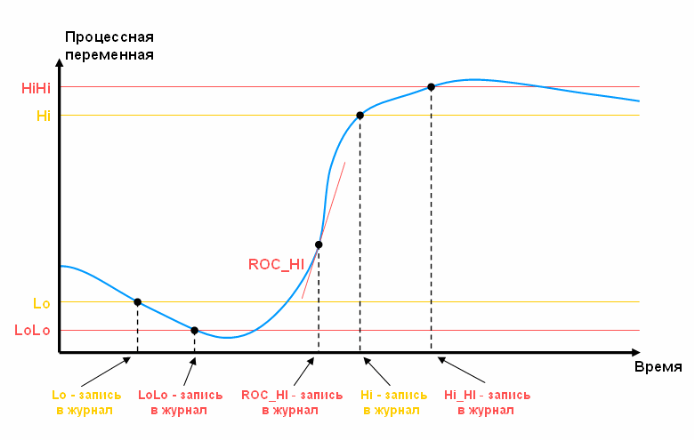
Рис. 4. Пример генерации аварийных сигналов и оповещений.Важность (или критичность) аварийного сигнала определяется приоритетом (целое число). Как правило, чем выше приоритет у аварийного сигнала, тем критичнее она для производства, и тем быстрее на нее надо обратить внимание.
При появлении аварийного сигнала у оператора есть два варианта действий:
1. Игнорировать его. Не всегда хорошее решение, мягко говоря. При этом если процессная переменная вернется обратно в нормальные границы, то появиться новое оповещение UNACK_RETURN_TO_NORMAL, говорящее о том, что оператор проспал аварийное событие, но, к счастью, все нормализовалось.
2. Подтвердить, что сигнал замечен оператором ( acknowledge). Дело в том, что сразу после появления аварийного сигнала ему автоматически присваивается статус UNACK (не подтвержден). Как только сигнал подтверждают (иногда говорят “квитируют”), его статус становится ACK (подтвержден). В этом случае возврат переменной в нормальные границы ведет к появлению оповещения ACK_RETURN_TO_NORMAL, свидетельствующее о том, что оператор “держит ухо востро”.
Аварийные сигналы можно произвольно группировать. На практике группировка проводится путем распределения процессных переменных, а следовательно, и соответствующих им аварийных сигналов по различным технологическим участкам ( plant areas) и установкам ( plant units).
[ http://kazanets.narod.ru/AlarmsArchive.htm]Тематики
Синонимы
EN
предупредительный сигнал
—
[Я.Н.Лугинский, М.С.Фези-Жилинская, Ю.С.Кабиров. Англо-русский словарь по электротехнике и электроэнергетике, Москва, 1999 г.]
предупредительный сигнал
—
[Л.Г.Суменко. Англо-русский словарь по информационным технологиям. М.: ГП ЦНИИС, 2003.]Тематики
- электротехника, основные понятия
EN
предупреждать об опасности
—
[А.С.Гольдберг. Англо-русский энергетический словарь. 2006 г.]Тематики
EN
сигнал тревоги
—
[Л.Г.Суменко. Англо-русский словарь по информационным технологиям. М.: ГП ЦНИИС, 2003.]
аларм
(в документации Schneider Electric)
-
[Интент]Тематики
Синонимы
EN
сигнализатор
Техническое средство, предназначенное для извещения о наличии или отсутствии физической величины установленного значения.
[РД 01.120.00-КТН-228-06]
сигнализатор
устройство аварийной сигнализации
Устройство, с помощью которого осуществляется подача звуковых или световых сигналов, предупреждающих обслуживающий персонал о неисправности или возникновении нештатной ситуации.
[Л.М. Невдяев. Телекоммуникационные технологии. Англо-русский толковый словарь-справочник. Под редакцией Ю.М. Горностаева. Москва, 2002]Тематики
- автоматизация, основные понятия
- электросвязь, основные понятия
Синонимы
EN
сигнализация
Устройство, обеспечивающее подачу звукового или светового сигнала при достижении предупредительного значения контролируемого параметра.
[ПБ 12-529-03 Правила безопасности систем газораспределения и газопотребления, утверждены постановлением Госгортехнадзора России от 18. 03. 2003 №9]
[СТО Газпром РД 2.5-141-2005]
сигнализация
-
[ ГОСТ Р 54325-2011 (IEC/TS 61850-2:2003)]Тематики
EN
сигнальное устройство
Устройство, осуществляющее визуальные или звуковые сигналы, привлекающие внимание обслуживающего персонала.
[ ГОСТ Р МЭК 60050-426-2006]
Тематики
EN
тревога (на охраняемом объекте)
Предупреждение о наличии опасности или угрозы для жизни человека (людей), ценностей (имущества), окружающей среды, выдаваемое техническим средством охраны/безопасности, людьми.
[РД 25.03.001-2002]Тематики
EN
устройство аварийной сигнализации
—
[Л.Г.Суменко. Англо-русский словарь по информационным технологиям. М.: ГП ЦНИИС, 2003.]Тематики
EN
3.3 сигнал тревоги (alarm): Указание на нарушение безопасности, необычное или опасное состояние, которое может потребовать немедленного внимания.
Источник: ГОСТ Р ИСО/ТО 13569-2007: Финансовые услуги. Рекомендации по информационной безопасности
3.2 сигнальное устройство (alarm): Электрооборудование, осуществляющее визуальные или звуковые сигналы, предназначенные для привлечения внимания.
Источник: ГОСТ Р МЭК 60079-13-2010: Взрывоопасные среды. Часть 13. Защита оборудования помещениями под избыточным давлением «p» оригинал документа
3.1 сигнальное устройство (alarm): Электрооборудование, осуществляющее визуальные или звуковые сигналы, предназначенные для привлечения внимания.
Источник: ГОСТ Р МЭК 60079-2-2009: Взрывоопасные среды. Часть 2. Оборудование с защитой вида заполнение или продувка оболочки под избыточным давлением "р" оригинал документа
3.1 предупреждение (alarm): Сигнал или сообщение, извещающее персонал о появлении отклонения или совокупности отклонений, требующих корректирующих действий.
Источник: ГОСТ Р ИСО 13379-2009: Контроль состояния и диагностика машин. Руководство по интерпретации данных и методам диагностирования оригинал документа
3.3 сигнал тревоги (alarm): Указание на нарушение безопасности, необычное или опасное состояние, которое может потребовать немедленного внимания.
Источник: ГОСТ Р ИСО ТО 13569-2007: Финансовые услуги. Рекомендации по информационной безопасности
Англо-русский словарь нормативно-технической терминологии > alarm
-
13 modular data center
модульный центр обработки данных (ЦОД)
-
[Интент]Параллельные тексты EN-RU
[ http://dcnt.ru/?p=9299#more-9299]
Data Centers are a hot topic these days. No matter where you look, this once obscure aspect of infrastructure is getting a lot of attention. For years, there have been cost pressures on IT operations and this, when the need for modern capacity is greater than ever, has thrust data centers into the spotlight. Server and rack density continues to rise, placing DC professionals and businesses in tighter and tougher situations while they struggle to manage their IT environments. And now hyper-scale cloud infrastructure is taking traditional technologies to limits never explored before and focusing the imagination of the IT industry on new possibilities.
В настоящее время центры обработки данных являются широко обсуждаемой темой. Куда ни посмотришь, этот некогда малоизвестный аспект инфраструктуры привлекает все больше внимания. Годами ИТ-отделы испытывали нехватку средств и это выдвинуло ЦОДы в центр внимания, в то время, когда необходимость в современных ЦОДах стала как никогда высокой. Плотность серверов и стоек продолжают расти, все больше усложняя ситуацию для специалистов в области охлаждения и организаций в их попытках управлять своими ИТ-средами. И теперь гипермасштабируемая облачная инфраструктура подвергает традиционные технологии невиданным ранее нагрузкам, и заставляет ИТ-индустрию искать новые возможности.
At Microsoft, we have focused a lot of thought and research around how to best operate and maintain our global infrastructure and we want to share those learnings. While obviously there are some aspects that we keep to ourselves, we have shared how we operate facilities daily, our technologies and methodologies, and, most importantly, how we monitor and manage our facilities. Whether it’s speaking at industry events, inviting customers to our “Microsoft data center conferences” held in our data centers, or through other media like blogging and white papers, we believe sharing best practices is paramount and will drive the industry forward. So in that vein, we have some interesting news to share.
В компании MicroSoft уделяют большое внимание изучению наилучших методов эксплуатации и технического обслуживания своей глобальной инфраструктуры и делятся результатами своих исследований. И хотя мы, конечно, не раскрываем некоторые аспекты своих исследований, мы делимся повседневным опытом эксплуатации дата-центров, своими технологиями и методологиями и, что важнее всего, методами контроля и управления своими объектами. Будь то доклады на отраслевых событиях, приглашение клиентов на наши конференции, которые посвящены центрам обработки данных MicroSoft, и проводятся в этих самых дата-центрах, или использование других средств, например, блоги и спецификации, мы уверены, что обмен передовым опытом имеет первостепенное значение и будет продвигать отрасль вперед.
Today we are sharing our Generation 4 Modular Data Center plan. This is our vision and will be the foundation of our cloud data center infrastructure in the next five years. We believe it is one of the most revolutionary changes to happen to data centers in the last 30 years. Joining me, in writing this blog are Daniel Costello, my director of Data Center Research and Engineering and Christian Belady, principal power and cooling architect. I feel their voices will add significant value to driving understanding around the many benefits included in this new design paradigm.
Сейчас мы хотим поделиться своим планом модульного дата-центра четвертого поколения. Это наше видение и оно будет основанием для инфраструктуры наших облачных дата-центров в ближайшие пять лет. Мы считаем, что это одно из самых революционных изменений в дата-центрах за последние 30 лет. Вместе со мной в написании этого блога участвовали Дэниел Костелло, директор по исследованиям и инжинирингу дата-центров, и Кристиан Белади, главный архитектор систем энергоснабжения и охлаждения. Мне кажется, что их авторитет придаст больше веса большому количеству преимуществ, включенных в эту новую парадигму проектирования.
Our “Gen 4” modular data centers will take the flexibility of containerized servers—like those in our Chicago data center—and apply it across the entire facility. So what do we mean by modular? Think of it like “building blocks”, where the data center will be composed of modular units of prefabricated mechanical, electrical, security components, etc., in addition to containerized servers.
Was there a key driver for the Generation 4 Data Center?Наши модульные дата-центры “Gen 4” будут гибкими с контейнерами серверов – как серверы в нашем чикагском дата-центре. И гибкость будет применяться ко всему ЦОД. Итак, что мы подразумеваем под модульностью? Мы думаем о ней как о “строительных блоках”, где дата-центр будет состоять из модульных блоков изготовленных в заводских условиях электрических систем и систем охлаждения, а также систем безопасности и т.п., в дополнение к контейнеризованным серверам.
Был ли ключевой стимул для разработки дата-центра четвертого поколения?
If we were to summarize the promise of our Gen 4 design into a single sentence it would be something like this: “A highly modular, scalable, efficient, just-in-time data center capacity program that can be delivered anywhere in the world very quickly and cheaply, while allowing for continued growth as required.” Sounds too good to be true, doesn’t it? Well, keep in mind that these concepts have been in initial development and prototyping for over a year and are based on cumulative knowledge of previous facility generations and the advances we have made since we began our investments in earnest on this new design.Если бы нам нужно было обобщить достоинства нашего проекта Gen 4 в одном предложении, это выглядело бы следующим образом: “Центр обработки данных с высоким уровнем модульности, расширяемости, и энергетической эффективности, а также возможностью постоянного расширения, в случае необходимости, который можно очень быстро и дешево развертывать в любом месте мира”. Звучит слишком хорошо для того чтобы быть правдой, не так ли? Ну, не забывайте, что эти концепции находились в процессе начальной разработки и создания опытного образца в течение более одного года и основываются на опыте, накопленном в ходе развития предыдущих поколений ЦОД, а также успехах, сделанных нами со времени, когда мы начали вкладывать серьезные средства в этот новый проект.
One of the biggest challenges we’ve had at Microsoft is something Mike likes to call the ‘Goldilock’s Problem’. In a nutshell, the problem can be stated as:
The worst thing we can do in delivering facilities for the business is not have enough capacity online, thus limiting the growth of our products and services.Одну из самых больших проблем, с которыми приходилось сталкиваться Майкрософт, Майк любит называть ‘Проблемой Лютика’. Вкратце, эту проблему можно выразить следующим образом:
Самое худшее, что может быть при строительстве ЦОД для бизнеса, это не располагать достаточными производственными мощностями, и тем самым ограничивать рост наших продуктов и сервисов.The second worst thing we can do in delivering facilities for the business is to have too much capacity online.
А вторым самым худшим моментом в этой сфере может слишком большое количество производственных мощностей.
This has led to a focus on smart, intelligent growth for the business — refining our overall demand picture. It can’t be too hot. It can’t be too cold. It has to be ‘Just Right!’ The capital dollars of investment are too large to make without long term planning. As we struggled to master these interesting challenges, we had to ensure that our technological plan also included solutions for the business and operational challenges we faced as well.
So let’s take a high level look at our Generation 4 designЭто заставило нас сосредоточиваться на интеллектуальном росте для бизнеса — refining our overall demand picture. Это не должно быть слишком горячим. И это не должно быть слишком холодным. Это должно быть ‘как раз, таким как надо!’ Нельзя делать такие большие капиталовложения без долгосрочного планирования. Пока мы старались решить эти интересные проблемы, мы должны были гарантировать, что наш технологический план будет также включать решения для коммерческих и эксплуатационных проблем, с которыми нам также приходилось сталкиваться.
Давайте рассмотрим наш проект дата-центра четвертого поколенияAre you ready for some great visuals? Check out this video at Soapbox. Click here for the Microsoft 4th Gen Video.
It’s a concept video that came out of my Data Center Research and Engineering team, under Daniel Costello, that will give you a view into what we think is the future.
From a configuration, construct-ability and time to market perspective, our primary goals and objectives are to modularize the whole data center. Not just the server side (like the Chicago facility), but the mechanical and electrical space as well. This means using the same kind of parts in pre-manufactured modules, the ability to use containers, skids, or rack-based deployments and the ability to tailor the Redundancy and Reliability requirements to the application at a very specific level.
Посмотрите это видео, перейдите по ссылке для просмотра видео о Microsoft 4th Gen:
Это концептуальное видео, созданное командой отдела Data Center Research and Engineering, возглавляемого Дэниелом Костелло, которое даст вам наше представление о будущем.
С точки зрения конфигурации, строительной технологичности и времени вывода на рынок, нашими главными целями и задачами агрегатирование всего дата-центра. Не только серверную часть, как дата-центр в Чикаго, но также системы охлаждения и электрические системы. Это означает применение деталей одного типа в сборных модулях, возможность использования контейнеров, салазок, или стоечных систем, а также возможность подстраивать требования избыточности и надежности для данного приложения на очень специфичном уровне.Our goals from a cost perspective were simple in concept but tough to deliver. First and foremost, we had to reduce the capital cost per critical Mega Watt by the class of use. Some applications can run with N-level redundancy in the infrastructure, others require a little more infrastructure for support. These different classes of infrastructure requirements meant that optimizing for all cost classes was paramount. At Microsoft, we are not a one trick pony and have many Online products and services (240+) that require different levels of operational support. We understand that and ensured that we addressed it in our design which will allow us to reduce capital costs by 20%-40% or greater depending upon class.
Нашими целями в области затрат были концептуально простыми, но трудно реализуемыми. В первую очередь мы должны были снизить капитальные затраты в пересчете на один мегаватт, в зависимости от класса резервирования. Некоторые приложения могут вполне работать на базе инфраструктуры с резервированием на уровне N, то есть без резервирования, а для работы других приложений требуется больше инфраструктуры. Эти разные классы требований инфраструктуры подразумевали, что оптимизация всех классов затрат имеет преобладающее значение. В Майкрософт мы не ограничиваемся одним решением и располагаем большим количеством интерактивных продуктов и сервисов (240+), которым требуются разные уровни эксплуатационной поддержки. Мы понимаем это, и учитываем это в своем проекте, который позволит нам сокращать капитальные затраты на 20%-40% или более в зависимости от класса.For example, non-critical or geo redundant applications have low hardware reliability requirements on a location basis. As a result, Gen 4 can be configured to provide stripped down, low-cost infrastructure with little or no redundancy and/or temperature control. Let’s say an Online service team decides that due to the dramatically lower cost, they will simply use uncontrolled outside air with temperatures ranging 10-35 C and 20-80% RH. The reality is we are already spec-ing this for all of our servers today and working with server vendors to broaden that range even further as Gen 4 becomes a reality. For this class of infrastructure, we eliminate generators, chillers, UPSs, and possibly lower costs relative to traditional infrastructure.
Например, некритичные или гео-избыточные системы имеют низкие требования к аппаратной надежности на основе местоположения. В результате этого, Gen 4 можно конфигурировать для упрощенной, недорогой инфраструктуры с низким уровнем (или вообще без резервирования) резервирования и / или температурного контроля. Скажем, команда интерактивного сервиса решает, что, в связи с намного меньшими затратами, они будут просто использовать некондиционированный наружный воздух с температурой 10-35°C и влажностью 20-80% RH. В реальности мы уже сегодня предъявляем эти требования к своим серверам и работаем с поставщиками серверов над еще большим расширением диапазона температур, так как наш модуль и подход Gen 4 становится реальностью. Для подобного класса инфраструктуры мы удаляем генераторы, чиллеры, ИБП, и, возможно, будем предлагать более низкие затраты, по сравнению с традиционной инфраструктурой.
Applications that demand higher level of redundancy or temperature control will use configurations of Gen 4 to meet those needs, however, they will also cost more (but still less than traditional data centers). We see this cost difference driving engineering behavioral change in that we predict more applications will drive towards Geo redundancy to lower costs.
Системы, которым требуется более высокий уровень резервирования или температурного контроля, будут использовать конфигурации Gen 4, отвечающие этим требованиям, однако, они будут также стоить больше. Но все равно они будут стоить меньше, чем традиционные дата-центры. Мы предвидим, что эти различия в затратах будут вызывать изменения в методах инжиниринга, и по нашим прогнозам, это будет выражаться в переходе все большего числа систем на гео-избыточность и меньшие затраты.
Another cool thing about Gen 4 is that it allows us to deploy capacity when our demand dictates it. Once finalized, we will no longer need to make large upfront investments. Imagine driving capital costs more closely in-line with actual demand, thus greatly reducing time-to-market and adding the capacity Online inherent in the design. Also reduced is the amount of construction labor required to put these “building blocks” together. Since the entire platform requires pre-manufacture of its core components, on-site construction costs are lowered. This allows us to maximize our return on invested capital.
Еще одно достоинство Gen 4 состоит в том, что он позволяет нам разворачивать дополнительные мощности, когда нам это необходимо. Как только мы закончим проект, нам больше не нужно будет делать большие начальные капиталовложения. Представьте себе возможность более точного согласования капитальных затрат с реальными требованиями, и тем самым значительного снижения времени вывода на рынок и интерактивного добавления мощностей, предусматриваемого проектом. Также снижен объем строительных работ, требуемых для сборки этих “строительных блоков”. Поскольку вся платформа требует предварительного изготовления ее базовых компонентов, затраты на сборку также снижены. Это позволит нам увеличить до максимума окупаемость своих капиталовложений.
Мы все подвергаем сомнениюIn our design process, we questioned everything. You may notice there is no roof and some might be uncomfortable with this. We explored the need of one and throughout our research we got some surprising (positive) results that showed one wasn’t needed.
В своем процессе проектирования мы все подвергаем сомнению. Вы, наверное, обратили внимание на отсутствие крыши, и некоторым специалистам это могло не понравиться. Мы изучили необходимость в крыше и в ходе своих исследований получили удивительные результаты, которые показали, что крыша не нужна.
Серийное производство дата центров
In short, we are striving to bring Henry Ford’s Model T factory to the data center. http://en.wikipedia.org/wiki/Henry_Ford#Model_T. Gen 4 will move data centers from a custom design and build model to a commoditized manufacturing approach. We intend to have our components built in factories and then assemble them in one location (the data center site) very quickly. Think about how a computer, car or plane is built today. Components are manufactured by different companies all over the world to a predefined spec and then integrated in one location based on demands and feature requirements. And just like Henry Ford’s assembly line drove the cost of building and the time-to-market down dramatically for the automobile industry, we expect Gen 4 to do the same for data centers. Everything will be pre-manufactured and assembled on the pad.Мы хотим применить модель автомобильной фабрики Генри Форда к дата-центру. Проект Gen 4 будет способствовать переходу от модели специализированного проектирования и строительства к товарно-производственному, серийному подходу. Мы намерены изготавливать свои компоненты на заводах, а затем очень быстро собирать их в одном месте, в месте строительства дата-центра. Подумайте о том, как сегодня изготавливается компьютер, автомобиль или самолет. Компоненты изготавливаются по заранее определенным спецификациям разными компаниями во всем мире, затем собираются в одном месте на основе спроса и требуемых характеристик. И точно так же как сборочный конвейер Генри Форда привел к значительному уменьшению затрат на производство и времени вывода на рынок в автомобильной промышленности, мы надеемся, что Gen 4 сделает то же самое для дата-центров. Все будет предварительно изготавливаться и собираться на месте.
Невероятно энергоэффективный ЦОД
And did we mention that this platform will be, overall, incredibly energy efficient? From a total energy perspective not only will we have remarkable PUE values, but the total cost of energy going into the facility will be greatly reduced as well. How much energy goes into making concrete? Will we need as much of it? How much energy goes into the fuel of the construction vehicles? This will also be greatly reduced! A key driver is our goal to achieve an average PUE at or below 1.125 by 2012 across our data centers. More than that, we are on a mission to reduce the overall amount of copper and water used in these facilities. We believe these will be the next areas of industry attention when and if the energy problem is solved. So we are asking today…“how can we build a data center with less building”?А мы упоминали, что эта платформа будет, в общем, невероятно энергоэффективной? С точки зрения общей энергии, мы получим не только поразительные значения PUE, но общая стоимость энергии, затраченной на объект будет также значительно снижена. Сколько энергии идет на производство бетона? Нам нужно будет столько энергии? Сколько энергии идет на питание инженерных строительных машин? Это тоже будет значительно снижено! Главным стимулом является достижение среднего PUE не больше 1.125 для всех наших дата-центров к 2012 году. Более того, у нас есть задача сокращения общего количества меди и воды в дата-центрах. Мы думаем, что эти задачи станут следующей заботой отрасли после того как будет решена энергетическая проблема. Итак, сегодня мы спрашиваем себя…“как можно построить дата-центр с меньшим объемом строительных работ”?
Строительство дата центров без чиллеровWe have talked openly and publicly about building chiller-less data centers and running our facilities using aggressive outside economization. Our sincerest hope is that Gen 4 will completely eliminate the use of water. Today’s data centers use massive amounts of water and we see water as the next scarce resource and have decided to take a proactive stance on making water conservation part of our plan.
Мы открыто и публично говорили о строительстве дата-центров без чиллеров и активном использовании в наших центрах обработки данных технологий свободного охлаждения или фрикулинга. Мы искренне надеемся, что Gen 4 позволит полностью отказаться от использования воды. Современные дата-центры расходуют большие объемы воды и так как мы считаем воду следующим редким ресурсом, мы решили принять упреждающие меры и включить экономию воды в свой план.
By sharing this with the industry, we believe everyone can benefit from our methodology. While this concept and approach may be intimidating (or downright frightening) to some in the industry, disclosure ultimately is better for all of us.
Делясь этим опытом с отраслью, мы считаем, что каждый сможет извлечь выгоду из нашей методологией. Хотя эта концепция и подход могут показаться пугающими (или откровенно страшными) для некоторых отраслевых специалистов, раскрывая свои планы мы, в конечном счете, делаем лучше для всех нас.
Gen 4 design (even more than just containers), could reduce the ‘religious’ debates in our industry. With the central spine infrastructure in place, containers or pre-manufactured server halls can be either AC or DC, air-side economized or water-side economized, or not economized at all (though the sanity of that might be questioned). Gen 4 will allow us to decommission, repair and upgrade quickly because everything is modular. No longer will we be governed by the initial decisions made when constructing the facility. We will have almost unlimited use and re-use of the facility and site. We will also be able to use power in an ultra-fluid fashion moving load from critical to non-critical as use and capacity requirements dictate.
Проект Gen 4 позволит уменьшить ‘религиозные’ споры в нашей отрасли. Располагая базовой инфраструктурой, контейнеры или сборные серверные могут оборудоваться системами переменного или постоянного тока, воздушными или водяными экономайзерами, или вообще не использовать экономайзеры. Хотя можно подвергать сомнению разумность такого решения. Gen 4 позволит нам быстро выполнять работы по выводу из эксплуатации, ремонту и модернизации, поскольку все будет модульным. Мы больше не будем руководствоваться начальными решениями, принятыми во время строительства дата-центра. Мы сможем использовать этот дата-центр и инфраструктуру в течение почти неограниченного периода времени. Мы также сможем применять сверхгибкие методы использования электрической энергии, переводя оборудование в режимы критической или некритической нагрузки в соответствии с требуемой мощностью.
Gen 4 – это стандартная платформаFinally, we believe this is a big game changer. Gen 4 will provide a standard platform that our industry can innovate around. For example, all modules in our Gen 4 will have common interfaces clearly defined by our specs and any vendor that meets these specifications will be able to plug into our infrastructure. Whether you are a computer vendor, UPS vendor, generator vendor, etc., you will be able to plug and play into our infrastructure. This means we can also source anyone, anywhere on the globe to minimize costs and maximize performance. We want to help motivate the industry to further innovate—with innovations from which everyone can reap the benefits.
Наконец, мы уверены, что это будет фактором, который значительно изменит ситуацию. Gen 4 будет представлять собой стандартную платформу, которую отрасль сможет обновлять. Например, все модули в нашем Gen 4 будут иметь общепринятые интерфейсы, четко определяемые нашими спецификациями, и оборудование любого поставщика, которое отвечает этим спецификациям можно будет включать в нашу инфраструктуру. Независимо от того производите вы компьютеры, ИБП, генераторы и т.п., вы сможете включать свое оборудование нашу инфраструктуру. Это означает, что мы также сможем обеспечивать всех, в любом месте земного шара, тем самым сводя до минимума затраты и максимальной увеличивая производительность. Мы хотим создать в отрасли мотивацию для дальнейших инноваций – инноваций, от которых каждый сможет получать выгоду.
Главные характеристики дата-центров четвертого поколения Gen4To summarize, the key characteristics of our Generation 4 data centers are:
Scalable
Plug-and-play spine infrastructure
Factory pre-assembled: Pre-Assembled Containers (PACs) & Pre-Manufactured Buildings (PMBs)
Rapid deployment
De-mountable
Reduce TTM
Reduced construction
Sustainable measuresНиже приведены главные характеристики дата-центров четвертого поколения Gen 4:
Расширяемость;
Готовая к использованию базовая инфраструктура;
Изготовление в заводских условиях: сборные контейнеры (PAC) и сборные здания (PMB);
Быстрота развертывания;
Возможность демонтажа;
Снижение времени вывода на рынок (TTM);
Сокращение сроков строительства;
Экологичность;Map applications to DC Class
We hope you join us on this incredible journey of change and innovation!
Long hours of research and engineering time are invested into this process. There are still some long days and nights ahead, but the vision is clear. Rest assured however, that we as refine Generation 4, the team will soon be looking to Generation 5 (even if it is a bit farther out). There is always room to get better.
Использование систем электропитания постоянного тока.
Мы надеемся, что вы присоединитесь к нам в этом невероятном путешествии по миру изменений и инноваций!
На этот проект уже потрачены долгие часы исследований и проектирования. И еще предстоит потратить много дней и ночей, но мы имеем четкое представление о конечной цели. Однако будьте уверены, что как только мы доведем до конца проект модульного дата-центра четвертого поколения, мы вскоре начнем думать о проекте дата-центра пятого поколения. Всегда есть возможность для улучшений.So if you happen to come across Goldilocks in the forest, and you are curious as to why she is smiling you will know that she feels very good about getting very close to ‘JUST RIGHT’.
Generations of Evolution – some background on our data center designsТак что, если вы встретите в лесу девочку по имени Лютик, и вам станет любопытно, почему она улыбается, вы будете знать, что она очень довольна тем, что очень близко подошла к ‘ОПИМАЛЬНОМУ РЕШЕНИЮ’.
Поколения эволюции – история развития наших дата-центровWe thought you might be interested in understanding what happened in the first three generations of our data center designs. When Ray Ozzie wrote his Software plus Services memo it posed a very interesting challenge to us. The winds of change were at ‘tornado’ proportions. That “plus Services” tag had some significant (and unstated) challenges inherent to it. The first was that Microsoft was going to evolve even further into an operations company. While we had been running large scale Internet services since 1995, this development lead us to an entirely new level. Additionally, these “services” would span across both Internet and Enterprise businesses. To those of you who have to operate “stuff”, you know that these are two very different worlds in operational models and challenges. It also meant that, to achieve the same level of reliability and performance required our infrastructure was going to have to scale globally and in a significant way.
Мы подумали, что может быть вам будет интересно узнать историю первых трех поколений наших центров обработки данных. Когда Рэй Оззи написал свою памятную записку Software plus Services, он поставил перед нами очень интересную задачу. Ветра перемен двигались с ураганной скоростью. Это окончание “plus Services” скрывало в себе какие-то значительные и неопределенные задачи. Первая заключалась в том, что Майкрософт собиралась в еще большей степени стать операционной компанией. Несмотря на то, что мы управляли большими интернет-сервисами, начиная с 1995 г., эта разработка подняла нас на абсолютно новый уровень. Кроме того, эти “сервисы” охватывали интернет-компании и корпорации. Тем, кому приходится всем этим управлять, известно, что есть два очень разных мира в области операционных моделей и задач. Это также означало, что для достижения такого же уровня надежности и производительности требовалось, чтобы наша инфраструктура располагала значительными возможностями расширения в глобальных масштабах.
It was that intense atmosphere of change that we first started re-evaluating data center technology and processes in general and our ideas began to reach farther than what was accepted by the industry at large. This was the era of Generation 1. As we look at where most of the world’s data centers are today (and where our facilities were), it represented all the known learning and design requirements that had been in place since IBM built the first purpose-built computer room. These facilities focused more around uptime, reliability and redundancy. Big infrastructure was held accountable to solve all potential environmental shortfalls. This is where the majority of infrastructure in the industry still is today.
Именно в этой атмосфере серьезных изменений мы впервые начали переоценку ЦОД-технологий и технологий вообще, и наши идеи начали выходить за пределы общепринятых в отрасли представлений. Это была эпоха ЦОД первого поколения. Когда мы узнали, где сегодня располагается большинство мировых дата-центров и где находятся наши предприятия, это представляло весь опыт и навыки проектирования, накопленные со времени, когда IBM построила первую серверную. В этих ЦОД больше внимания уделялось бесперебойной работе, надежности и резервированию. Большая инфраструктура была призвана решать все потенциальные экологические проблемы. Сегодня большая часть инфраструктуры все еще находится на этом этапе своего развития.
We soon realized that traditional data centers were quickly becoming outdated. They were not keeping up with the demands of what was happening technologically and environmentally. That’s when we kicked off our Generation 2 design. Gen 2 facilities started taking into account sustainability, energy efficiency, and really looking at the total cost of energy and operations.
Очень быстро мы поняли, что стандартные дата-центры очень быстро становятся устаревшими. Они не поспевали за темпами изменений технологических и экологических требований. Именно тогда мы стали разрабатывать ЦОД второго поколения. В этих дата-центрах Gen 2 стали принимать во внимание такие факторы как устойчивое развитие, энергетическая эффективность, а также общие энергетические и эксплуатационные.
No longer did we view data centers just for the upfront capital costs, but we took a hard look at the facility over the course of its life. Our Quincy, Washington and San Antonio, Texas facilities are examples of our Gen 2 data centers where we explored and implemented new ways to lessen the impact on the environment. These facilities are considered two leading industry examples, based on their energy efficiency and ability to run and operate at new levels of scale and performance by leveraging clean hydro power (Quincy) and recycled waste water (San Antonio) to cool the facility during peak cooling months.
Мы больше не рассматривали дата-центры только с точки зрения начальных капитальных затрат, а внимательно следили за работой ЦОД на протяжении его срока службы. Наши объекты в Куинси, Вашингтоне, и Сан-Антонио, Техас, являются образцами наших ЦОД второго поколения, в которых мы изучали и применяли на практике новые способы снижения воздействия на окружающую среду. Эти объекты считаются двумя ведущими отраслевыми примерами, исходя из их энергетической эффективности и способности работать на новых уровнях производительности, основанных на использовании чистой энергии воды (Куинси) и рециклирования отработанной воды (Сан-Антонио) для охлаждения объекта в самых жарких месяцах.
As we were delivering our Gen 2 facilities into steel and concrete, our Generation 3 facilities were rapidly driving the evolution of the program. The key concepts for our Gen 3 design are increased modularity and greater concentration around energy efficiency and scale. The Gen 3 facility will be best represented by the Chicago, Illinois facility currently under construction. This facility will seem very foreign compared to the traditional data center concepts most of the industry is comfortable with. In fact, if you ever sit around in our container hanger in Chicago it will look incredibly different from a traditional raised-floor data center. We anticipate this modularization will drive huge efficiencies in terms of cost and operations for our business. We will also introduce significant changes in the environmental systems used to run our facilities. These concepts and processes (where applicable) will help us gain even greater efficiencies in our existing footprint, allowing us to further maximize infrastructure investments.
Так как наши ЦОД второго поколения строились из стали и бетона, наши центры обработки данных третьего поколения начали их быстро вытеснять. Главными концептуальными особенностями ЦОД третьего поколения Gen 3 являются повышенная модульность и большее внимание к энергетической эффективности и масштабированию. Дата-центры третьего поколения лучше всего представлены объектом, который в настоящее время строится в Чикаго, Иллинойс. Этот ЦОД будет выглядеть очень необычно, по сравнению с общепринятыми в отрасли представлениями о дата-центре. Действительно, если вам когда-либо удастся побывать в нашем контейнерном ангаре в Чикаго, он покажется вам совершенно непохожим на обычный дата-центр с фальшполом. Мы предполагаем, что этот модульный подход будет способствовать значительному повышению эффективности нашего бизнеса в отношении затрат и операций. Мы также внесем существенные изменения в климатические системы, используемые в наших ЦОД. Эти концепции и технологии, если применимо, позволят нам добиться еще большей эффективности наших существующих дата-центров, и тем самым еще больше увеличивать капиталовложения в инфраструктуру.
This is definitely a journey, not a destination industry. In fact, our Generation 4 design has been under heavy engineering for viability and cost for over a year. While the demand of our commercial growth required us to make investments as we grew, we treated each step in the learning as a process for further innovation in data centers. The design for our future Gen 4 facilities enabled us to make visionary advances that addressed the challenges of building, running, and operating facilities all in one concerted effort.
Это определенно путешествие, а не конечный пункт назначения. На самом деле, наш проект ЦОД четвертого поколения подвергался серьезным испытаниям на жизнеспособность и затраты на протяжении целого года. Хотя необходимость в коммерческом росте требовала от нас постоянных капиталовложений, мы рассматривали каждый этап своего развития как шаг к будущим инновациям в области дата-центров. Проект наших будущих ЦОД четвертого поколения Gen 4 позволил нам делать фантастические предположения, которые касались задач строительства, управления и эксплуатации объектов как единого упорядоченного процесса.
Тематики
Синонимы
EN
Англо-русский словарь нормативно-технической терминологии > modular data center
-
14 risk assessment
Gen Mgtthe determination of the level of risk in a particular course of action. Risk assessments are an important tool in areas such as health and safety management and environmental management. Results of a risk assessment can be used, for example, to identify areas in which safety can be improved. Risk assessment can also be used to determine more intangible forms of risk, including economic and social risk, and can inform the scenario planning process. The amount of risk involved in a particular course of action is compared to its expected benefits to provide evidence for decision making. -
15 Vermuyden, Sir Cornelius
SUBJECT AREA: Civil engineering[br]b. c. 1590 St Maartensdijk, Zeeland, the Netherlandsd. 4 February 1656 probably London, England[br]Dutch/British civil engineer responsible for many of the drainage and flood-protection schemes in low-lying areas of England in the seventeenth century.[br]At the beginning of the seventeenth century, several wealthy men in England joined forces as "adventurers" to put their money into land ventures. One such group was responsible for the draining of the Fens. The first need was to find engineers who were versed in the processes of land drainage, particularly when that land was at, or below, sea level. It was natural, therefore, to turn to the Netherlands to find these skilled men. Joachim Liens was one of the first of the Dutch engineers to go to England, and he started work on the Great Level; however, no real progress was made until 1621, when Cornelius Vermuyden was brought to England to assist in the work.Vermuyden had grown up in a district where he could see for himself the techniques of embanking and reclaiming land from the sea. He acquired a reputation of expertise in this field, and by 1621 his fame had spread to England. In that year the Thames had flooded and breached its banks near Havering and Dagenham in Essex. Vermuyden was commissioned to repair the breach and drain neighbouring marshland, with what he claimed as complete success. The Commissioners of Sewers for Essex disputed this claim and whthheld his fee, but King Charles I granted him a portion of the reclaimed land as compensation.In 1626 Vermuyden carried out his first scheme for drainage works as a consultant. This was the drainage of Hatfield Chase in South Yorkshire. Charles I was, in fact, Vermuyden's employer in the drainage of the Chase, and the work was undertaken as a means of raising additional rents for the Royal Exchequer. Vermuyden was himself an "adventurer" in the undertaking, putting capital into the venture and receiving the title to a considerable proportion of the drained lands. One of the important elements of his drainage designs was the principal of "washes", which were flat areas between the protective dykes and the rivers to carry flood waters, to prevent them spreading on to nearby land. Vermuyden faced bitter opposition from those whose livelihoods depended on the marshlands and who resorted to sabotage of the embankments and violence against his imported Dutch workmen to defend their rights. The work could not be completed until arbiters had ruled out on the respective rights of the parties involved. Disagreements and criticism of his engineering practices continued and he gave up his interest in Hatfield Chase. The Hatfield Chase undertaking was not a great success, although the land is now rich farmland around the river Don in Doncaster. However, the involved financial and land-ownership arrangements were the key to the granting of a knighthood to Cornelius Vermuyden in January 1628, and in 1630 he purchased 4,000 acres of low-lying land on Sedgemoor in Somerset.In 1629 Vermuyden embarked on his most important work, that of draining the Great Level in the fenlands of East Anglia. Francis Russell, 4th Earl of Bedford, was given charge of the work, with Vermuyden as Engineer; in this venture they were speculators and partners and were recompensed by a grant of land. The area which contains the Cambridgeshire tributaries of the Great Ouse were subject to severe and usually annual flooding. The works to contain the rivers in their flood period were important. Whilst the rivers were contained with the enclosed flood plain, the land beyond became highly sought-after because of the quality of the soil. The fourteen "adventurers" who eventually came into partnership with the Earl of Bedford and Vermuyden were the financiers of the scheme and also received land in accordance with their input into the scheme. In 1637 the work was claimed to be complete, but this was disputed, with Vermuyden defending himself against criticism in a pamphlet entitled Discourse Touching the Great Fennes (1638; 1642, London). In fact, much remained to be done, and after an interruption due to the Civil War the scheme was finished in 1652. Whilst the process of the Great Level works had closely involved the King, Oliver Cromwell was equally concerned over the success of the scheme. By 1655 Cornelius Vermuyden had ceased to have anything to do with the Great Level. At that stage he was asked to account for large sums granted to him to expedite the work but was unable to do so; most of his assets were seized to cover the deficiency, and from then on he subsided into obscurity and poverty.While Cornelius Vermuyden, as a Dutchman, was well versed in the drainage needs of his own country, he developed his skills as a hydraulic engineer in England and drained acres of derelict flooded land.[br]Principal Honours and DistinctionsKnighted 1628.Further ReadingL.E.Harris, 1953, Vermuyden and the Fens, London: Cleaver Hume Press. J.Korthals-Altes, 1977, Sir Cornelius Vermuyden: The Lifework of a Great Anglo-Dutchman in Land-Reclamation and Drainage, New York: Alto Press.KM / LRDBiographical history of technology > Vermuyden, Sir Cornelius
-
16 Mind
It becomes, therefore, no inconsiderable part of science... to know the different operations of the mind, to separate them from each other, to class them under their proper heads, and to correct all that seeming disorder in which they lie involved when made the object of reflection and inquiry.... It cannot be doubted that the mind is endowed with several powers and faculties, that these powers are distinct from one another, and that what is really distinct to the immediate perception may be distinguished by reflection and, consequently, that there is a truth and falsehood which lie not beyond the compass of human understanding. (Hume, 1955, p. 22)Let us then suppose the mind to be, as we say, white Paper, void of all Characters, without any Ideas: How comes it to be furnished? Whence comes it by that vast store, which the busy and boundless Fancy of Man has painted on it, with an almost endless variety? Whence has it all the materials of Reason and Knowledge? To this I answer, in one word, from Experience. (Locke, quoted in Herrnstein & Boring, 1965, p. 584)The kind of logic in mythical thought is as rigorous as that of modern science, and... the difference lies, not in the quality of the intellectual process, but in the nature of things to which it is applied.... Man has always been thinking equally well; the improvement lies, not in an alleged progress of man's mind, but in the discovery of new areas to which it may apply its unchanged and unchanging powers. (Leґvi-Strauss, 1963, p. 230)MIND. A mysterious form of matter secreted by the brain. Its chief activity consists in the endeavor to ascertain its own nature, the futility of the attempt being due to the fact that it has nothing but itself to know itself with. (Bierce, quoted in Minsky, 1986, p. 55)[Philosophy] understands the foundations of knowledge and it finds these foundations in a study of man-as-knower, of the "mental processes" or the "activity of representation" which make knowledge possible. To know is to represent accurately what is outside the mind, so to understand the possibility and nature of knowledge is to understand the way in which the mind is able to construct such representation.... We owe the notion of a "theory of knowledge" based on an understanding of "mental processes" to the seventeenth century, and especially to Locke. We owe the notion of "the mind" as a separate entity in which "processes" occur to the same period, and especially to Descartes. We owe the notion of philosophy as a tribunal of pure reason, upholding or denying the claims of the rest of culture, to the eighteenth century and especially to Kant, but this Kantian notion presupposed general assent to Lockean notions of mental processes and Cartesian notions of mental substance. (Rorty, 1979, pp. 3-4)Under pressure from the computer, the question of mind in relation to machine is becoming a central cultural preoccupation. It is becoming for us what sex was to Victorians-threat, obsession, taboo, and fascination. (Turkle, 1984, p. 313)7) Understanding the Mind Remains as Resistant to Neurological as to Cognitive AnalysesRecent years have been exciting for researchers in the brain and cognitive sciences. Both fields have flourished, each spurred on by methodological and conceptual developments, and although understanding the mechanisms of mind is an objective shared by many workers in these areas, their theories and approaches to the problem are vastly different....Early experimental psychologists, such as Wundt and James, were as interested in and knowledgeable about the anatomy and physiology of the nervous system as about the young science of the mind. However, the experimental study of mental processes was short-lived, being eclipsed by the rise of behaviorism early in this century. It was not until the late 1950s that the signs of a new mentalism first appeared in scattered writings of linguists, philosophers, computer enthusiasts, and psychologists.In this new incarnation, the science of mind had a specific mission: to challenge and replace behaviorism. In the meantime, brain science had in many ways become allied with a behaviorist approach.... While behaviorism sought to reduce the mind to statements about bodily action, brain science seeks to explain the mind in terms of physiochemical events occurring in the nervous system. These approaches contrast with contemporary cognitive science, which tries to understand the mind as it is, without any reduction, a view sometimes described as functionalism.The cognitive revolution is now in place. Cognition is the subject of contemporary psychology. This was achieved with little or no talk of neurons, action potentials, and neurotransmitters. Similarly, neuroscience has risen to an esteemed position among the biological sciences without much talk of cognitive processes. Do the fields need each other?... [Y]es because the problem of understanding the mind, unlike the wouldbe problem solvers, respects no disciplinary boundaries. It remains as resistant to neurological as to cognitive analyses. (LeDoux & Hirst, 1986, pp. 1-2)Since the Second World War scientists from different disciplines have turned to the study of the human mind. Computer scientists have tried to emulate its capacity for visual perception. Linguists have struggled with the puzzle of how children acquire language. Ethologists have sought the innate roots of social behaviour. Neurophysiologists have begun to relate the function of nerve cells to complex perceptual and motor processes. Neurologists and neuropsychologists have used the pattern of competence and incompetence of their brain-damaged patients to elucidate the normal workings of the brain. Anthropologists have examined the conceptual structure of cultural practices to advance hypotheses about the basic principles of the mind. These days one meets engineers who work on speech perception, biologists who investigate the mental representation of spatial relations, and physicists who want to understand consciousness. And, of course, psychologists continue to study perception, memory, thought and action.... [W]orkers in many disciplines have converged on a number of central problems and explanatory ideas. They have realized that no single approach is likely to unravel the workings of the mind: it will not give up its secrets to psychology alone; nor is any other isolated discipline-artificial intelligence, linguistics, anthropology, neurophysiology, philosophy-going to have any greater success. (Johnson-Laird, 1988, p. 7)Historical dictionary of quotations in cognitive science > Mind
-
17 slash and burn culture
- вырубка и сжигание леса как метод увеличения сельскохозяйственных площадей
вырубка и сжигание леса как метод увеличения сельскохозяйственных площадей
—
[ http://www.eionet.europa.eu/gemet/alphabetic?langcode=en]EN
slash and burn culture
A traditional farming system that has been used by generations of farmers in tropical forests and the savannah of north and east Africa. It is known to be an ecologically sound form of cultivation, and because the soil is poor in tropical rain forests it is a sustainable method of farming. It is still practised today, primarily in the developing countries. Small areas of bush or forests are cleared and the smaller trees burned. This unlocks the nutrients in the vegetation and gives the soil fertilizer that is easily taken up by plants. A few years later the soil is degraded and the farmer moves on to do the same at another site. The original ground is left fallow for anything up to 20 years so that the forest can regenerate. With the growth in population and in the subsequent need for more farming land to produce food, the method is increasingly being used today to clear large areas of tropical forests for cattle ranching, and in most cases the ground is not left fallow for long enough and, with modern mechanized farming systems, not enough tree stumps or suitable habitats for plant life are left to start the regeneration process. (Source: WRIGHT)
[http://www.eionet.europa.eu/gemet/alphabetic?langcode=en]Тематики
EN
DE
FR
Англо-русский словарь нормативно-технической терминологии > slash and burn culture
-
18 continual improvement
последовательное улучшение
Процесс совершенствования системы экологического менеджмента с целью улучшения общей экологической результативности в соответствии с экологической политикой организации.
Примечание
Этот процесс не обязательно происходит одновременно во всех сферах деятельности.
[ http://www.14000.ru/glossary/main.php?PHPSESSID=25e3708243746ef7c85d0a8408d768af]EN
continual improvement
Process of enhancing the environmental management system to achieve improvements in overall environmental performance in line with the organization's environmental policy.
Note
The process need not take place in all areas of activity simultaneously.
[ISO 14001]Тематики
EN
постоянное улучшение
Повторяющаяся деятельность по увеличению способности выполнить требования.
Примечание
Процесс установления целей и поиска возможностей улучшения является постоянным процессом, использующим наблюдения аудита и заключения по результатам аудита, анализ данных, анализ со стороны руководства или другие средства и обычно ведущим к корректирующим действиям или предупреждающим действиям.
[ ГОСТ Р ИСО 9000-2008]
постоянное улучшение
Процесс усовершенствования системы управления окружающей средой с целью повышения общей экологической эффективности в соответствии с экологической политикой организации
[ ГОСТ Р ИСО 14001-98]
Примечание
Этот процесс необязательно происходит одновременно во всех сферах деятельности.
[ ГОСТ Р ИСО 14050-99]
[Защита атмосферного воздуха от антропогенного загрязнения. Основные понятия, термины и определения (справочное пособие). Санкт-Петербург 2003 г.]Тематики
EN
3.2 постоянное улучшение (continual improvement): Повторяющийся процесс совершенствования системы экологического менеджмента (3.8) с целью улучшения общей экологической результативности (3.10) в соответствии с экологической политикой (3.11) организации (3.16).
Примечание - Этот процесс не обязательно проходит одновременно во всех сферах деятельности.
Источник: ГОСТ Р ИСО 14001-2007: Системы экологического менеджмента. Требования и руководство по применению оригинал документа
3.2.13 постоянное улучшение (continual improvement): Повторяющаяся деятельность по увеличению способности выполнить требования (3.1.2).
Примечание - Процесс (3.4.1) установления целей и поиска возможностей улучшения является постоянным процессом, использующим наблюдения аудита (3.9.5)и заключения по результатам аудита (3.9.6), анализ данных, анализ (3.8.7) со стороны руководства или другие средства и обычно ведущим к корректирующим действиям (3.6.5)или предупреждающим действиям (3.6.4).
Источник: ГОСТ Р ИСО 9000-2008: Системы менеджмента качества. Основные положения и словарь оригинал документа
3.10 постоянное улучшение (continual improvement): Периодически повторяющийся процесс усиления системы менеджмента безопасности для усовершенствования всей работы в отношении безопасности, соответствующей политике организации в этой области.
Источник: ГОСТ Р 53661-2009: Система менеджмента безопасности цепи поставок. Руководство по внедрению оригинал документа
3.11 постоянное улучшение (continual improvement): Периодически повторяющийся процесс усиления системы менеджмента безопасности для усовершенствования всей работы в отношении безопасности, соответствующей политике организации в этой области.
Источник: ГОСТ Р 53663-2009: Система менеджмента безопасности цепи поставок. Требования оригинал документа
3.2 постоянное улучшение (continual improvement): Повторяющийся процесс совершенствования системы экологического менеджмента (3.9), с целью улучшения общей экологической результативности (3.11) в соответствии с экологической политикой (3.20) организации (3.13).
Примечание - Этот процесс не обязательно проходит одновременно во всех сферах деятельности.
[ИСО 14001:2004, 3.2]
Источник: ГОСТ Р ИСО 14004-2007: Системы экологического менеджмента. Общее руководство по принципам, системам и методам обеспечения функционирования оригинал документа
ное улучшение (continual improvement) - процесс усовершенствования системы управления окружающей средой с целью повышения общей экологической эффективности в соответствии с экологической политикой организации.
Примечание - Этот процесс необязательно происходит одновременно во всех сферах деятельности.
Источник: ГОСТ Р ИСО 14050-99: Управление окружающей средой. Словарь оригинал документа
3.2 постоянное улучшение (continual improvement): Повторяющийся процесс совершенствования системы экологического менеджмента (3.8) с целью улучшения общей экологической результативности (3.10) в соответствии с экологической политикой (3.11) организации (3.16).
Примечание - Этот процесс необязательно проходит одновременно во всех сферах деятельности
Источник: ГОСТ Р 54336-2011: Системы экологического менеджмента в организациях, выпускающих нанопродукцию. Требования оригинал документа
3.2.13 постоянное улучшение (continual improvement): Повторяющаяся деятельность по увеличению способности выполнить требования (3.1.2).
Примечание - Процесс (3.4.1) установления целей и поиска возможностей улучшения является постоянным процессом, использующим наблюдения аудита (3.9.5)и заключения по результатам аудита (3.9.6), анализ данных, анализ (3.8.7) со стороны руководства или другие средства и обычно ведущим к корректирующим действиям (3.6.5)или предупреждающим действиям (3.6.4).
Источник: ГОСТ ISO 9000-2011: Системы менеджмента качества. Основные положения и словарь
3.3 постоянное улучшение (continual improvement): Повторяющийся процесс совершенствования системы менеджмента БТиОЗ (см. 3.13), направленный на улучшение общих показателей деятельности в области БТиОЗ (см. 3.15) в соответствии с политикой в области БТиОЗ (см. 3.16) организации (см. 3.17).
Примечания
1 Этот процесс не обязательно должен проходить во всех областях деятельности одновременно.
2 Адаптировано из ИСО 14001, пункт 3.2.
Источник: ГОСТ Р 54934-2012: Системы менеджмента безопасности труда и охраны здоровья. Требования оригинал документа
3.3 постоянное улучшение (continual improvement): Повторяющийся процесс совершенствования системы менеджмента ОЗиБТ (см. 3.13), осуществляемый с целью добиться улучшения общих показателей деятельности в области ОЗиБТ (см. 3.15), при согласованности с политикой в области ОЗиБТ (см. 3.16)организации (см. 3.17).
Примечания
1 Этот процесс необязательно проходит одновременно во всех сферах деятельности.
2 Адаптировано из ГОСТ Р ИСО 14001, статья 3.2.
Источник: ГОСТ Р 54337-2011: Системы менеджмента охраны труда в организациях, выпускающих нанопродукцию. Требования оригинал документа
3.2.18 постоянное улучшение (continual improvement): Повторяющаяся деятельность по увеличению способности выполнить требования.
Источник: ГОСТ Р 54147-2010: Стратегический и инновационный менеджмент. Термины и определения оригинал документа
4.7 последовательное улучшение (continual improvement): Повторяющийся процесс (6.4) совершенствования системы экологического менеджмента (4.1) для достижения улучшения общей экологической результативности (3.16), согласующийся с экологической политикой (4.1.1) организации (3.4).
Примечание - Процесс не обязательно проводят во всех областях деятельности одновременно.
[ИСО 14001:2004]
Источник: ГОСТ Р ИСО 14050-2009: Менеджмент окружающей среды. Словарь оригинал документа
Англо-русский словарь нормативно-технической терминологии > continual improvement
-
19 departmentalization
сущ.1) упр. департаментализация, выделение (разделение организации на отделы, выделение групп)departmentalization of the state into various ethnic groupings — выделение нескольких этнических групп внутри штата
departmentalization of instruction into various subject areas — разделение преподавательской деятельности на отдельные предметные области
Syn:See:customer departmentalization, functional departmentalization, process departmentalization, product departmentalization, geographical departmentalization, customer departmentalization, matrix departmentalization2) упр. департаментализация*а) (разбиение организации на отделы, каждый из которых специализируется на определенном виде деятельности и имеет управляющего)б) марк. (разделение магазина на отделы, причем каждый отдел специализируется на продаже определенного вида товаров и имеет отдельного управляющего/заведующего отделом)See: -
20 semi-structured interview
соц. полуструктурированное интервью (интервью, состоящее как из заранее подготовленных вопросов, так и из дополнительных вопросов интервьюера, возникающих в ходе беседы)One advantage of the semi-structured interview is the flexibility to explore areas of questions as they arise during the interview process. — Одно из преимуществ полуструктурированного интервью — возможность обсуждать вопросы, естественным образом возникающие по ходу интервьюирования.
See:Англо-русский экономический словарь > semi-structured interview
См. также в других словарях:
Process area (CMMI) — The latest version of Capability Maturity Model Integration (CMMI) CMMI for Development, Version 1.3 contains 22 Process Areas that describe the aspects of product development that are to be covered by organizational processes. Contents 1 Process … Wikipedia
Process optimization — is the discipline of adjusting a process so as to optimize some specified set of parameters without violating some constraint. The most common goals are minimizing cost, maximizing throughput, and/or efficiency. This is one of the major… … Wikipedia
process — process, procedure, proceeding denote the series of actions, operations, or motions involved in the accomplishment of an end. Process is particularly appropriate when progress from a definite beginning to a definite end is implied and something… … New Dictionary of Synonyms
Process theory of composition — The process theory of composition (hereafter referred to as process ) is a field of composition studies that focuses on writing as a process rather than a product. Based on Janet Emig s breakdown of the writing process, [Emig, Janet. The… … Wikipedia
Process management (computing) — Operating systems … Wikipedia
IBM Tivoli Unified Process (ITUP) — is a knowledge base of widely accepted industry best practices and the accumulated experience from IBM s client engagements. The knowledge base is comprised of detailed, industry wide IT service management processes, and is an integral part of… … Wikipedia
Business process management — (BPM) is a method of efficiently aligning an organization with the wants and needs of clients. It is a holistic management approach that promotes business effectiveness and efficiency while striving for innovation, flexibility and integration… … Wikipedia
Secretariat for Coordinating the Peace Process (SCOPP) — Born out of a need to institutionalize the Peace Process, the Secretariat for Coordinating the Peace Process (SCOPP) was established on 06 February 2002 with the approval of the Cabinet of Ministers of the Government of Sri Lanka (GOSL). The… … Wikipedia
Business process — A business process or business method is a collection of related, structured activities or tasks that produce a specific service or product (serve a particular goal) for a particular customer or customers. It often can be visualized with a… … Wikipedia
Northern Ireland peace process — The peace process, when discussing the history of Northern Ireland, is often considered to cover the events leading up to the 1994 Provisional Irish Republican Army (IRA) ceasefire, the end of most of the violence of the Troubles, the Belfast (or … Wikipedia
Peace process in the Israeli–Palestinian conflict — Part of a series on the Israeli–Palestinian conflict and Arab–Israeli conflict Israeli–Palestinian peace process … Wikipedia
